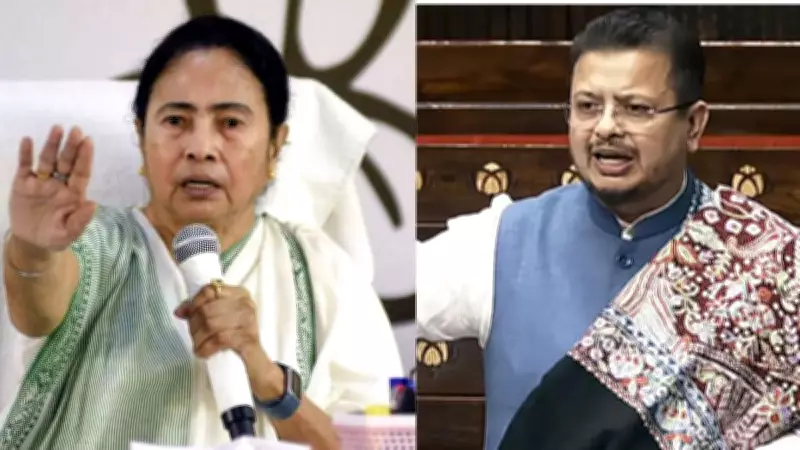
West Bengal Chief Minister Mamata Banerjee has formally approached the Election Commission of India (EC) following the announcement of a new committee by a rival faction of the Trinamool Congress (TMC) led by Ritabrata Banerjee. The move underscores the deepening fissures within the party, which has been the dominant political force in the state since 2011.
Background of the Factional Dispute
The rival faction, styling itself as the "Real TMC," declared its own organizational structure on June 22, 2026, claiming to represent the original ideals of the party. Ritabrata Banerjee, a former TMC leader who was expelled in 2023 for anti-party activities, heads this splinter group. The faction's new committee includes several former TMC functionaries who were sidelined in recent years.
Mamata Banerjee, in her petition to the EC, has sought recognition of her faction as the legitimate TMC, arguing that the rival group has no organizational or electoral mandate. She has also requested the EC to freeze the party's symbol—the jora ghas phul (two flowers and grass)—until the dispute is resolved. According to sources, the CM's legal team has submitted affidavits and documentary evidence to support her claim.

EC's Role and Precedents
The Election Commission has the authority to adjudicate intra-party disputes under the Representation of the People Act, 1951. In past cases, such as the split in the Shiv Sena in 2022, the EC recognized the faction led by Eknath Shinde as the official party after a test of majority support. Legal experts say the TMC case could follow a similar trajectory, with the EC likely to examine the membership strength of each faction.
Political analyst Dr. Suman Das commented, "The EC will assess which faction commands the majority of the party's elected representatives and grassroots workers. This is a crucial test for Mamata Banerjee's leadership, as any adverse ruling could weaken her hold over the party machinery."
Rival Faction's Claims
Ritabrata Banerjee, addressing a press conference in Kolkata on June 23, asserted that his faction represents the "true spirit" of the TMC. "We are not anti-Mamata; we are anti-autocracy. The party has strayed from its democratic roots," he said. The faction has claimed support from at least 15% of the party's district-level office bearers, though independent verification remains pending.
The rival committee includes several former TMC MLAs who lost their seats in the 2026 assembly elections. Critics, however, dismiss the faction as a "pressure group" with negligible public support. TMC spokesperson Kunal Ghosh stated, "This is a manufactured revolt by disgruntled elements who have no mass base. The party stands united under Didi's leadership."
Implications for West Bengal Politics
The internal strife comes at a critical juncture for the TMC, which faces a resurgent BJP and a newly formed alliance of Left and Congress parties ahead of the 2029 general elections. Mamata Banerjee's government has been grappling with issues such as unemployment, inflation, and allegations of corruption in the education sector. The factional feud could distract the party from these challenges.
Political observers note that the EC's decision will have far-reaching consequences. If Mamata Banerjee's faction retains the party symbol and name, the rival group may be forced to contest under a new banner, diluting its impact. Conversely, if the EC recognizes the rival faction, it could trigger a split in the TMC's legislative wing, potentially destabilizing the state government.
Next Steps
The EC has acknowledged receipt of Mamata Banerjee's petition and is expected to issue notices to both factions within a week. A hearing is likely to be scheduled after the monsoon session of Parliament. In the meantime, both sides are mobilizing support from party workers and elected representatives.
Mamata Banerjee has called for a meeting of all TMC MPs and MLAs on July 1 to demonstrate unity. Meanwhile, the rival faction plans to hold a rally in Kolkata on June 30 to showcase its strength. The coming weeks will be crucial in determining the trajectory of one of India's most prominent regional parties.