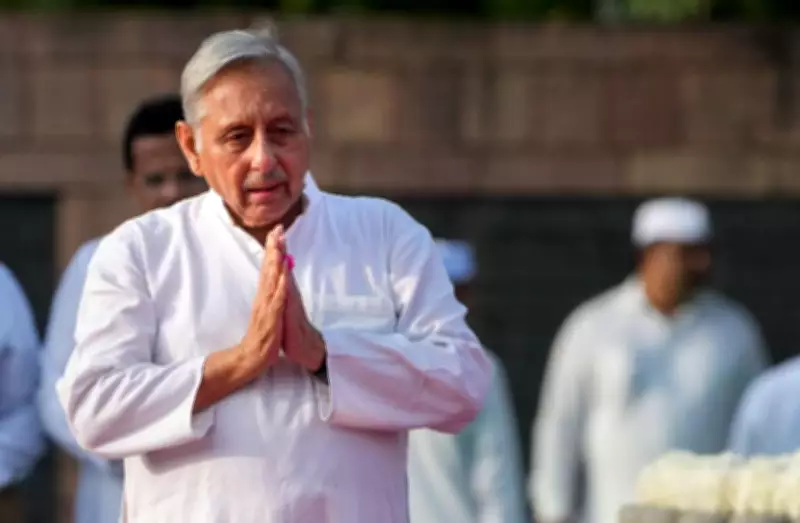
Mani Shankar Aiyar's Ideological Declaration Ignites Congress Infighting Speculation
Senior Congress leader and former diplomat Mani Shankar Aiyar has stirred a political storm with a pointed remark about his ideological leanings within the party. In a statement that has quickly gone viral, Aiyar declared, "I am a Gandhian, Nehruvian, and Rajivian, but not a Rahulian." This comment, made in the context of internal party dynamics, has sparked intense debate and speculation about potential rifts within the Congress as it gears up for the 2026 political landscape.
Context and Timing of the Controversial Statement
The remark comes at a critical juncture for the Congress, which is navigating leadership challenges and ideological repositioning ahead of future elections. Aiyar, known for his outspoken views and long-standing association with the party, made this statement during a discussion on the party's direction and legacy. By explicitly distancing himself from the term "Rahulian," which implies allegiance to Rahul Gandhi's leadership and vision, Aiyar has highlighted what many see as underlying tensions between different factions within the Congress.
This is not the first time Aiyar has been at the center of controversy; his previous comments have often led to public disagreements, but this latest assertion touches directly on the core of the party's identity and future trajectory. Observers note that the timing, with the 2026 elections looming, adds significant weight to his words, potentially signaling deeper discontent among veteran leaders.

Analysis of the Ideological Labels
To understand the full impact of Aiyar's statement, it's essential to break down the ideological labels he invoked:
- Gandhian: Refers to the principles of Mahatma Gandhi, emphasizing non-violence, truth, and grassroots empowerment.
- Nehruvian: Pertains to the vision of Jawaharlal Nehru, focusing on secularism, socialism, and scientific temper.
- Rajivian: Relates to the legacy of Rajiv Gandhi, highlighting modernization, technology, and youth engagement.
- Rahulian: A newer term associated with Rahul Gandhi's leadership, often linked to issues like social justice, economic reform, and anti-corruption campaigns.
By aligning himself with the first three but rejecting the fourth, Aiyar appears to be making a statement about the continuity—or lack thereof—in the party's ideological evolution. This has led to questions about whether he views Rahul Gandhi's approach as a departure from the traditional Congress values embodied by earlier leaders.
Reactions and Implications for the Congress Party
The reaction within political circles has been swift and varied. Some party members have downplayed the remark as a personal opinion, while others see it as a reflection of broader dissatisfaction among older guard leaders who may feel sidelined by the current leadership's strategies. Political analysts suggest that this could exacerbate existing divisions within the Congress, potentially affecting its cohesion and electoral prospects.
Moreover, this incident raises important questions about the party's ability to unify under a common vision. As the Congress works to rebuild its base and counter opposition forces, such public disagreements could undermine its messaging and voter appeal. The focus now shifts to how the party leadership, including Rahul Gandhi, responds to this challenge and whether steps will be taken to address these ideological concerns.
In the broader context, Aiyar's statement also touches on the ongoing debate about political legacies in India. It highlights how historical figures like Gandhi, Nehru, and Rajiv Gandhi continue to shape contemporary politics, even as new leaders seek to carve their own paths. This dynamic is not unique to the Congress but is a recurring theme in Indian political discourse.

Looking Ahead to 2026 and Beyond
As the political landscape evolves, the Congress faces the dual task of honoring its rich heritage while adapting to modern challenges. Aiyar's remark serves as a reminder of the delicate balance required in this process. Whether this leads to internal reforms or further fragmentation remains to be seen, but it undoubtedly adds a new layer of complexity to the party's preparations for the 2026 elections.
In conclusion, Mani Shankar Aiyar's declaration has ignited a significant discussion on ideology and leadership within the Congress. By framing his identity in terms of historical legacies rather than current leadership, he has prompted a reevaluation of what it means to be a Congress member today. This episode underscores the ongoing struggles within one of India's oldest political parties as it navigates a rapidly changing political environment.