

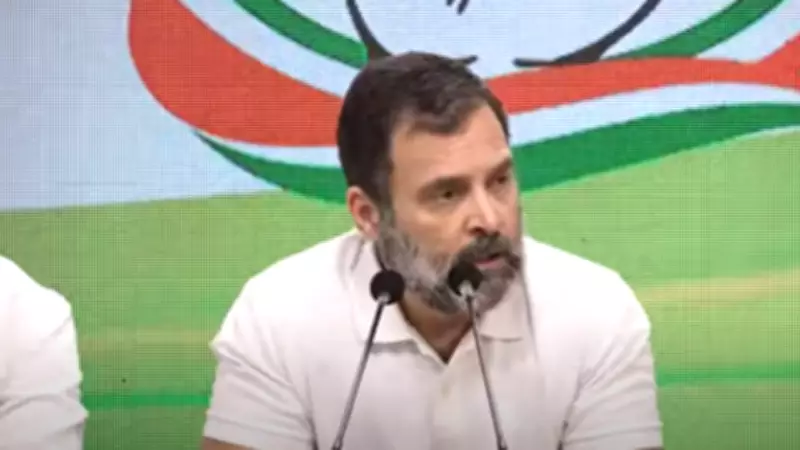
Rahul Gandhi's Fiery Accusation: Centre 'Sold Bharat Mata' in US Trade Deal
In a dramatic escalation of political rhetoric, Leader of Opposition in Lok Sabha Rahul Gandhi has accused the central government of having "sold out Bharat Mata" through the India-US interim trade agreement. The Congress leader made these explosive allegations during a debate on the Union Budget, framing the deal as a "wholesale surrender" of national interests.
Parliamentary Confrontation Escalates Outside House
Minutes after his charged parliamentary speech, Gandhi confronted ministers Ashwini Vaishnaw and Prahlad Joshi as they addressed reporters outside the House. The interruption occurred while IT Minister Vaishnaw was emphasizing the importance of data authentication and responsible statements.
"Come, let's stand together. Let's do it together," Gandhi said, approaching the ministers from behind as they attempted to disengage from the confrontation.

Martial Arts Analogy and Sovereignty Concerns
In his Lok Sabha address, Gandhi employed a martial arts analogy to describe what he called a "chokehold" on Prime Minister Narendra Modi by the United States. "Why has he sold India - because they are choking him. They have a grip on his neck," Gandhi asserted, suggesting no Indian prime minister would agree to such terms voluntarily.
The Congress leader challenged earlier statements by PM Modi and National Security Advisor Ajit Doval about the era of war being over. "In fact, we are moving into the era of war. War is there in Ukraine, war was there in Gaza, war is there in the Middle East, threat of war is there in Iran," he stated, emphasizing the need for stronger national safeguards.
Three-Point INDIA Bloc Alternative
Gandhi outlined what an INDIA bloc government would have demanded in negotiations:
- Data Sovereignty: "The most important asset in this equation is Indian data. If the US wants to protect the dollar, it must recognize that Indian data is the biggest asset."
- Equal Partnership: "If you want access to it, then you will talk to us as an equal, not talk to us as if we are your servants."
- Energy and Agricultural Protection: Declaring energy security non-negotiable and protecting Indian farmers' interests.
Allegations of Energy Weaponization
The Congress leader made specific claims about the trade deal's implications:
- India's energy security effectively ceded to US control
- Americans would decide oil procurement sources
- Potential tariffs up to 50% for non-compliance
- Enabling "energy and financial weaponization" against India
"How can you come to this House and defend this? Are you not ashamed of what you are giving away?" Gandhi challenged government members, repeatedly asking if they felt "no shame" for "selling our mother - Bharat Mata."
Treasury Bench Pushback
Treasury bench MPs consistently objected during Gandhi's speech, calling the allegations "baseless" and demanding authentication of claims. Gandhi responded that he was willing to comply with verification requests while maintaining his position on what he characterized as a fundamental compromise of national sovereignty.
The confrontation highlights deepening political divisions over India's international trade agreements and their perceived impact on national autonomy, with data security, energy independence, and agricultural protection emerging as central battlegrounds in the ongoing parliamentary debate.






