

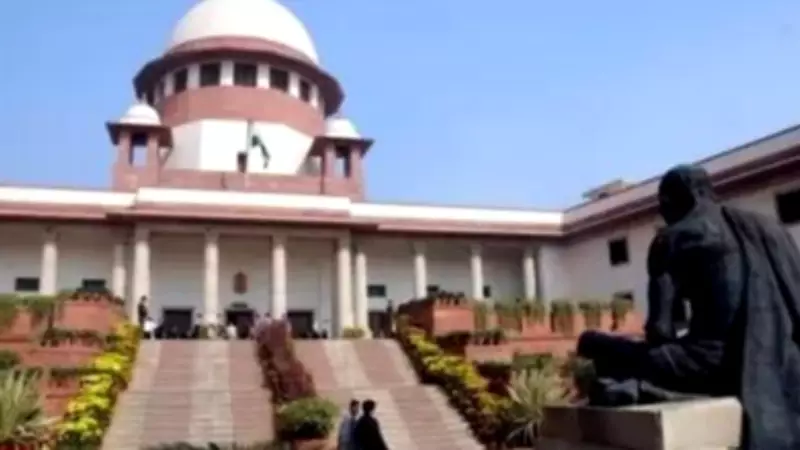
The Supreme Court on Friday declared that citizens have a fundamental right to walk, which is integral to the right to life and free movement under the Constitution. The court urged the Union government to enact a law mandating well-demarcated footpaths for every road to ensure pedestrian safety.
The ruling came from a bench of Justices P S Narasimha and A S Chandurkar, who were moved by the death of a five-year-old boy while walking to a neighborhood school. The bench stated, "Right to walk is a fundamental right under Part III of the Constitution. It is integral to the right to movement guaranteed under Article 19(1)(d), read with Article 19(1)(a), Article 19(1)(b), Article 19(1)(c) and Article 21 of the Constitution."
Writing the judgment, Justice Narasimha said, "The fundamental right to walk will take within its sweep the right to demarcated footpaths. These rights are primary and shall have priority over movement by motorised vehicles." The court emphasized that if a road exists, there is a duty to ensure a footpath is demarcated and maintained for walkers. This duty is enforceable, and the fundamental right to walk on demarcated footpaths overrides the privilege of a motorised vehicle.

The Supreme Court cast a constitutional duty on the government and civic bodies in the three-tier governance system. It stated, "The duty bearers are the urban development authorities, municipal corporations, municipalities and even panchayats, who must endeavour to demarcate, construct, maintain and safeguard footpaths and other necessary pedestrian infrastructure, as walking is integral to life."
Interestingly, the court noted that violation of the right to walk, being a fundamental right, would entitle citizens to file writ petitions before the Supreme Court and High Courts to seek remedies against civic authorities and governments for restitution and compensation. This right to move constitutional courts would be independent of the citizens' right to seek compensation through motor accident claims tribunals under the Motor Vehicles Act.
Rechristening the individual claims case as 'Re: Fundamental Right to Walk and Footpath', the bench observed that although the right to walk on a demarcated footpath is integral to the right to life and free movement, there is no legislation to guarantee this right. The court directed its registry to send a copy of the judgment to the Union ministries of housing and urban affairs, rural development, and road transport and highways to enable them to reflect on "the compelling necessity for initiating the necessary legal framework." The bench said it was high time to frame a statutory mechanism "not only for declaring the right, but also to recognise the duty bearers."
The court also urged the Law Commission to examine formulating a statutory framework for protecting the right, identifying the duty bearers, and laying down remedies. "Constitutional courts also have a duty to declare with clarity the existence of this fundamental right and ensure that the existing civil and the constitutional remedies are accessible and effective," Justices Narasimha and Chandurkar said.
While awarding compensation of Rs 11.5 lakh to the father of the deceased minor, the bench remarked, "A wide, well-demarcated and uninterrupted footpath can change the beauty of, and equitable access to, our cities and towns and could truly be transformative of our urban and rural living." The court questioned, "In reality, how much does it take to create a well-demarcated footpath wherever a road exists? All that the fundamental right to walk demands is a comfortable space for an easy and carefree walk. Should this not be the minimum of the minimum duty that a municipal authority owes to the citizens?"






