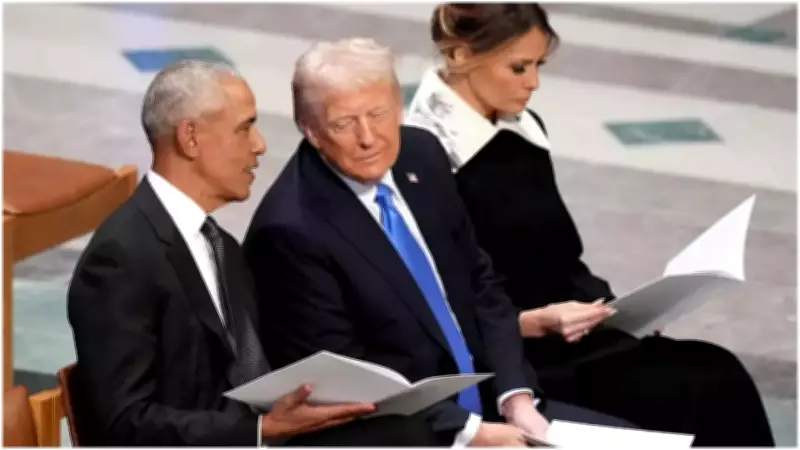
Trump's Persistent Focus on Obama Reignites Political Tensions
Nearly a decade after Barack Obama departed from the White House, Donald Trump maintains a relentless focus on his predecessor, consistently placing Obama at the heart of political assaults, online debates, and viral controversies. This pattern has recently resurfaced with Trump's latest social media activity, underscoring a deep-seated obsession that has defined much of Trump's political career.
AI-Generated Videos Amplify the Feud
Trump's fixation with Obama is no secret, as evidenced by his sharing of an AI-generated video on his Truth Social account. Originally posted on X in October 2025, this video depicted prominent Democrats as animals bowing before Trump. This follows a similar incident last year, where Trump circulated another AI-generated clip showing him being forcibly detained by the FBI and pacing in a jail cell, based on footage from a meeting.
Why does Obama remain such a central figure for Trump? The reasons are multifaceted. The AI-generated content appears to project Trump's fears and envy regarding Obama's composure, intellect, and global stature. More importantly, it reflects how Obama's presidency redefined perceptions of power and leadership in America, challenging long-held assumptions and leaving a legacy that continues to influence political discourse.

Historical Context and Personal Grievances
For years, Obama has occupied a significant space in Trump's political psyche. Some analysts trace Trump's decision to run for president back to the 2011 White House Correspondents' Dinner, where Obama publicly mocked him. On the campaign trail, Trump has repeatedly conflated Obama with President Joe Biden, at times erroneously claiming he "beat Obama" in the 2016 election. He has even compared their health, asserting he is fitter than his predecessor.
Trump's obsession extends to accolades, such as the Nobel Peace Prize, which Obama won. Trump has spent years coveting this award, criticizing Obama's achievement by stating, "He got it for doing nothing. Obama got a prize - he didn't even know what - he got elected, and they gave it to Obama for doing absolutely nothing but destroying our country." In contrast, Trump has boasted about preventing wars, saying, "I've stopped eight wars, so that's never happened before - but they'll have to do what they do. Whatever they do is fine. I know this: I didn't do it for that, I did it because I saved a lot of lives."
The Birther Theory and Its Lasting Impact
Trump's political ascent was significantly fueled by his fixation on Obama, particularly through the birther conspiracy theory. This false claim alleged that Obama was foreign-born, un-American, and illegitimate, helping Trump build a loyal base by capitalizing on racial resentment. In March 2011, Trump publicly expressed doubts about Obama's birth certificate, sending investigators to Hawaii and offering a $5 million charity donation for proof of Obama's U.S. birth.
Despite the Obama White House releasing the long-form birth certificate on April 27, 2011, to quell rumors, Trump continued to question its authenticity. In 2012, he tweeted about an "extremely credible source" calling it fraudulent, and in 2013, he cast suspicion on the death of a Hawaiian official who verified the document. A year later, he urged hackers to access Obama's college records to check his birthplace, perpetuating the conspiracy.
Dismantling Obama's Legacy
As president, Trump systematically worked to undo Obama's achievements, including exiting the Iran nuclear deal, attempting to repeal the Affordable Care Act (Obamacare), and frequently blaming Obama for policy shortcomings. Meanwhile, Obama campaigned against Trump in 2016 and 2020, claiming he could have defeated Trump in a third term. This ongoing feud, blending policy disagreements with personal animosity, has persisted into Trump's second term, finding new expression in posts like the recent AI-generated video.
This long-running conflict highlights how Trump's obsession with Obama continues to shape political narratives, using modern technology and historical grievances to keep the feud alive in the public eye.