

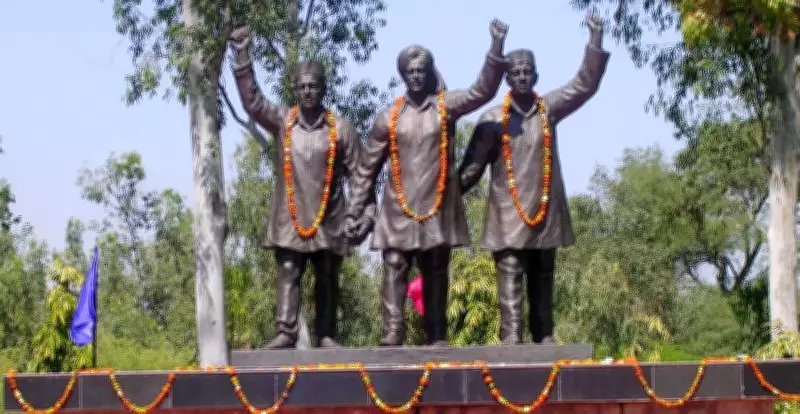
Why Bhagat Singh Defies Easy Labels and Categorization
Bhagat Singh was not merely a young man who died prematurely. He was a revolutionary who consciously chose death as a political act. At the age of 23, when many individuals are still navigating their paths, he achieved a remarkable clarity that seamlessly connected thought with decisive action. His sacrifice was neither impulsive nor tragic in a conventional sense—it was deliberate, reasoned, and profoundly political. Fully aware of the consequences, he embraced them with unwavering conviction, understanding the inevitability of the gallows yet moving forward with a resolve that transformed his death into a powerful instrument of national awakening.
The Unity of Intellect and Action
In Bhagat Singh, ideas did not remain confined to theoretical discussions or books; they found their ultimate fulfilment in tangible action. To begin understanding him, one must start not by quantifying how much he read or assigning simplistic labels, but by recognizing the rare unity of intellect, purpose, and sacrifice that defined his entire existence. This unity makes attempts to define his intellectual identity both compelling and inherently problematic.
In a recent article titled "Why Bhagat Singh was not a Marxist thinker," scholar Bhagwan Josh cautions against interpreting Bhagat Singh as a systematic Marxist and questions the tendency to equate textual engagement with genuine ideological commitment. This intervention is significant, especially as it marks a departure from Josh's earlier position. In his previous Punjabi work, Josh extensively argued for Bhagat Singh's Marxist orientation, placing him within a distinct Leninist current emerging in Punjab between 1928 and 1931—an intellectual formation grounded in rigorous study, debate, and ideological seriousness, distinct from more pragmatic strands within Indian communism.

Shifting Interpretations and Historical Tensions
The contrast between Josh's two positions is striking. Earlier, Bhagat Singh appeared as part of a developing Marxist trajectory; now, he is distanced from that framework because mere textual engagement does not necessarily translate into ideological practice. This shift is not merely interpretive but reveals a deeper tension within historiography itself: should Bhagat Singh be understood through the texts he encountered, or through the political conditions in which he acted and the choices he ultimately made?
In this context, comparisons are often drawn with figures like Che Guevara, an Argentine Marxist revolutionary, and Antonio Gramsci, an Italian Marxist philosopher. However, such comparisons, while intellectually tempting, can obscure more than they illuminate. Gramsci's intellectual formation was rooted in sustained engagement with European philosophical traditions, producing a systematic body of theoretical work. Guevara emerged from a different historical trajectory in Latin America, where revolutionary action and ideological articulation evolved within distinct contexts.
Bhagat Singh's Unique Path and Pragmatic Engagement
Bhagat Singh's path was neither identical nor derivative. He entered the national movement propelled not by a completed ideological system but by an inherited political consciousness, sharpened by lived experience and directed by intense moral resolve—a jazba (passion) that preceded and anchored his later intellectual engagements. Reading him solely through such comparisons risks mistaking resemblance for equivalence.
Bhagat Singh did not write to construct abstract theories; he read, selected, and deployed ideas in the urgency of political struggle. His writings do not aspire to systematic closure; they bear the marks of a mind working under pressure—absorbing, testing, and reshaping thought in direct relation to action. The search for a fixed ideological label, therefore, tells us less about Bhagat Singh and more about our own desire for intellectual categorization.

Limitations of Quantifying His Reading
The recurring emphasis on the number of books he read reveals its limitations. Claims that Bhagat Singh read several hundred books, often repeated without scrutiny, have acquired the status of fact. Yet these claims rest on a fragile methodological base. Much of the supporting material does not constitute a personal record of reading but emerges from a wider archival context shaped by colonial surveillance and collective activity within revolutionary networks.
The same caution applies to interpreting his 'Jail Notebook.' It has often been treated as evidence of systematic study, with the number of quotations taken as an index of books read. However, the notebook is a working document—an assemblage of extracts, phrases, and reflections that Bhagat Singh found useful or striking. Treating it as a bibliographical record imposes a structure it was never meant to bear.
A Mind in Motion and Resistance to Simplification
What emerges instead is not a closed ideological system but a mind in motion—engaging with diverse sources, absorbing ideas, and reshaping them in response to immediate political needs. His references span revolutionary, nationalist, and socialist writings, but they do not resolve into a single doctrinal identity. They point to an evolving and pragmatic engagement with ideas.
Attempts to fix Bhagat Singh within rigid categories—Marxist, anarchist, nationalist—often tell us more about our own need for classification than about his thought. It is easier to assign labels than to engage with complexity, and easier to count books than to understand what reading meant in a life shaped by urgency, risk, and purpose.
Enduring Legacy and Moral Clarity
Bhagat Singh's life resists such simplification. His courtroom statements, hunger strikes, and prison writings reveal a figure who combined intellectual curiosity with remarkable moral clarity. His critique of imperialism was inseparable from a vision of a just and egalitarian society, yet it remained open, dynamic, and responsive to context.
When a student, worker, or farmer raises the cry of "Inquilab zindabad," the question of ideological classification dissolves. The slogan survives because it speaks to a condition, not a doctrine. Similarly, Gandhi continues to inspire acts of resistance in contexts unimaginable in his own time.
In the end, Bhagat Singh does not need to be measured by the number of books he read nor confined within the boundaries of any single ideology. At age 23, he consciously embraced death, transforming his trial and execution into a political act of enduring significance. His greatness lies not in accumulated reading, but in the clarity with which he understood his time—and the courage with which he chose to act within it.





