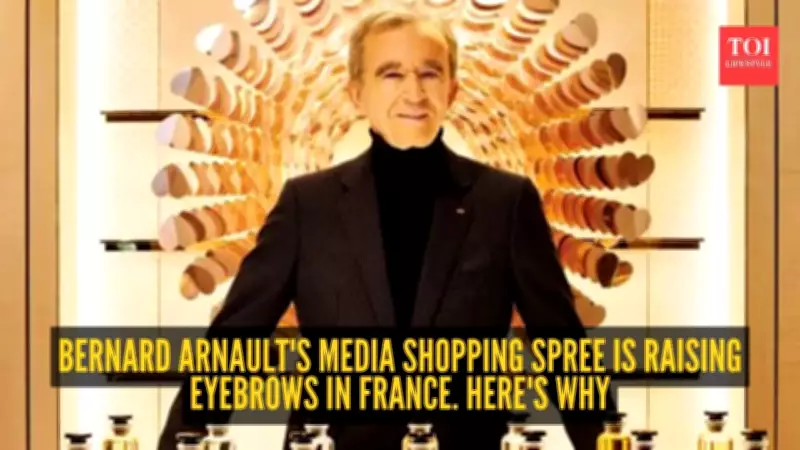
When people hear the name Bernard Arnault, they usually think of luxury. Louis Vuitton handbags. Dior couture. Tiffany jewellery. The kind of brands most of us admire from a distance while scrolling through Instagram.
But in France, the billionaire behind LVMH is making headlines for something that has nothing to do with fashion. His growing collection of newspapers and business publications is sparking a heated debate about who controls the news and how much influence one powerful businessman should have over it.
According to a recent report by The Guardian, journalists, media unions and press freedom groups are becoming increasingly concerned after LVMH acquired Challenges, one of France's most prominent business magazines. For many people, it wasn't just another corporate takeover. It felt like one more piece of France's business media puzzle falling into Arnault's hands.

The luxury tycoon already owns Les Echos, one of the country's biggest financial newspapers, along with business news service L'Agefi. He also controls Le Parisien and celebrity magazine Paris Match. That growing list has prompted some critics to ask a simple question: when one of the richest men in the world also owns a large chunk of the media covering business and economics, should people be worried?
Not everyone thinks so. Arnault has long maintained that his investments help keep important publications alive at a time when newspapers everywhere are struggling to survive. Speaking before a French Senate committee a few years ago, he said his involvement in media was driven by the public interest and a desire to protect major titles.
But many journalists remain unconvinced. Reporters Without Borders, the international press freedom organisation, has been particularly vocal. As reported by The Guardian, the group argues that Arnault now exerts enormous influence over France's business press and has challenged the acquisition through legal channels. Journalists' unions have also joined the fight, fearing that too much ownership concentrated in one place could eventually affect editorial independence.
Their concern isn't necessarily that someone will pick up the phone and dictate tomorrow's headlines. It's more subtle than that. Many media experts argue that ownership alone can shape newsroom culture over time. Editors may feel pressure. Certain stories may receive more attention than others. Some topics might become harder to pursue aggressively when they involve the interests of powerful owners. Whether that actually happens is often difficult to prove. But the concern itself isn't new.
And Arnault isn't the only billionaire at the centre of this debate. France has seen a growing number of ultra-wealthy business figures buying newspapers, television channels and publishing companies. Vincent Bolloré, Rodolphe Saadé and Daniel Křetínský have all expanded their media holdings in recent years. Together, they've helped transform the country's media landscape into one increasingly shaped by billionaire owners.
Still, Arnault stands apart simply because of his scale. With a fortune estimated by Forbes at around $145 billion, he's not just France's richest businessman. He's one of the richest people on Earth. That makes every acquisition feel bigger. Every purchase attracts more scrutiny. And every move raises fresh questions.
The timing is also important. France is heading towards a politically significant period as attention slowly turns to the country's next presidential election. At moments like these, discussions about media influence tend to become even more intense. Who owns the news? Who shapes public debate? And how independent can journalism remain when powerful economic interests sit behind major publications?
Those questions aren't unique to France. They're being asked in countries around the world. What's happening there simply puts the issue under a brighter spotlight. For now, legal challenges related to the Challenges acquisition are still being considered by French authorities. The outcome remains uncertain.
But one thing is clear. The conversation is no longer just about luxury handbags, champagne brands or fashion empires. It's about power. And in modern France, few people have accumulated more of it than Bernard Arnault.