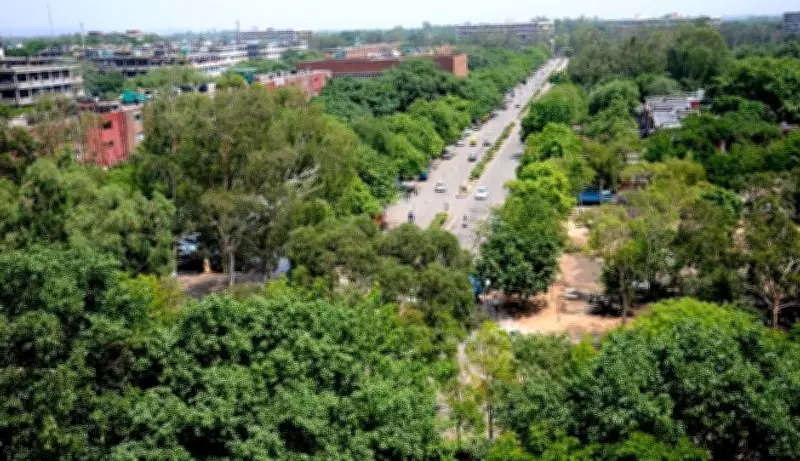
The Chandigarh Administration's proposed amendments to the Chandigarh Master Plan 2031 would fundamentally alter the city's founding principles, doubling and tripling Floor Area Ratio (FAR) and permitting 30-metre-high buildings in residential and peripheral zones. The Punjab and Haryana High Court, in a May 29 judgment, reaffirmed the plan's inviolability and ruled against a flyover at Tribune Chowk, citing heritage protections.
What the Amendments Propose
On May 22, the Administration notified draft amendments to the Master Plan, followed by a supplementary addendum on May 29. Key changes include: raising FAR from 1.2 to 3.0 in Phase III residential areas, allowing heights up to 30 metres (approximately 10 storeys), imposing stilt-plus-four and stilt-plus-five building formats on neighbourhoods not designed for them, opening industrial plots to mixed residential and commercial use, and reclassifying over 400 acres of reserve land for commercial development. The public was given 21 days to respond.
Why Chandigarh Is Unique
Designed by Le Corbusier, Pierre Jeanneret, Jane Drew, and Maxwell Fry, Chandigarh was built on principles of Sun, Space, and Verdure as inviolable rights. The city is structured as a human body: Capitol Complex as Head, City Centre as Heart, Leisure Valley as Lungs. Its seven-tier road hierarchy separates traffic from pedestrians. The Capitol Complex is a UNESCO World Heritage site, and the city is recognized as Modern Heritage of Universal Value. The Master Plan 2031 set a terminal population ceiling of 16 lakh based on audited infrastructure limits.

High Court Ruling: Key Holdings
On May 29, a Division Bench of Chief Justice Sheel Nagu and Justice Sanjiv Berry scrapped the proposed flyover at Tribune Chowk. The court held that the Master Plan is inviolable and mandatory, that flyovers are banned city-wide due to heritage considerations, that heritage protections apply uniformly across all phases, and that the city was built for people, not vehicles. It noted Chandigarh has more registered vehicles than residents, the highest per capita car ownership in India. Five directions were issued: prohibit the flyover, permit an underpass, ban tree cutting, maintain heritage character of Phase I, and promote public transport.
Opposition from Experts and Officials
Sumit Kaur, former Chief Architect who led the Master Plan's formulation, filed a 19-page objection. She argues the process is procedurally flawed: a consultant was hired to study holding capacity only after notifications were issued. She demands eight mandatory studies—infrastructure audit, traffic impact, environmental assessment, seismic vulnerability, holding capacity reassessment, social infrastructure gap, microclimate study, and heritage impact assessment—none of which have been conducted. She warns that stilt-plus-four typologies create seismic failure risk in Zone IV, 30-metre towers sever the Shivalik view corridor, and high-intensity zoning near Manimajra violates a 2022 MoEFCC ruling protecting a migratory bird corridor.
MP Manish Tewari submitted objections targeting process and substance. He notes the expert committee comprises eleven government officers with no independent experts, violating the Master Plan's mandate for a multidisciplinary panel. He demands reconstitution with six independent experts and two public representatives, and extension of the objection period to 60 days with ward sabhas. He calls for a publicly disclosed ward-wise civic infrastructure blueprint before any density increase, citing failed water supply and waste management projects as evidence of inadequate infrastructure.
Zone-by-Zone Impact
In Residential Phase II and III, new plotted development is halted; all new housing must be high-density group housing with stilt-plus-four formats. Phase III FAR rises 150% to 3.0, with heights up to 30 metres. Institutional FAR for schools rises from 1.25 to 2.0, for colleges and hospitals from 1.50 to 2.5, and minimum land norms for private schools are removed. In peripheral zones Maloya and Manimajra, 178 acres in Maloya Pocket 7 are designated for 30-metre high-rise housing at 250 persons per acre. The Industrial Area receives blanket FAR of 2.0 and 60% ground coverage, replacing site-specific controls. The Mixed Land Use corridor on Vikas Marg expands from 252 acres to 428 acres, consuming reserve land.

Legal Precedents and Next Steps
Two Supreme Court rulings create binding obligations: RWA v. UT Chandigarh (2023) mandates Heritage Conservation Committee vetting and infrastructure carrying-capacity tests; Tata Housing v. Aalok Jagga (2019) prohibits high-rises near Sukhna Wildlife Sanctuary under the Public Trust Doctrine. The screening committee must consider all objections. Experts demand withdrawal of amendments until mandatory studies are completed and the expert committee is reconstituted. The Chandigarh Regional Planning Board, mandated in the Master Plan but never activated, must be formed to direct growth outward. Residents can submit objections to the Chief Architect or petition ward representatives. The High Court's May 29 judgment serves as a legal instrument for challenges.