

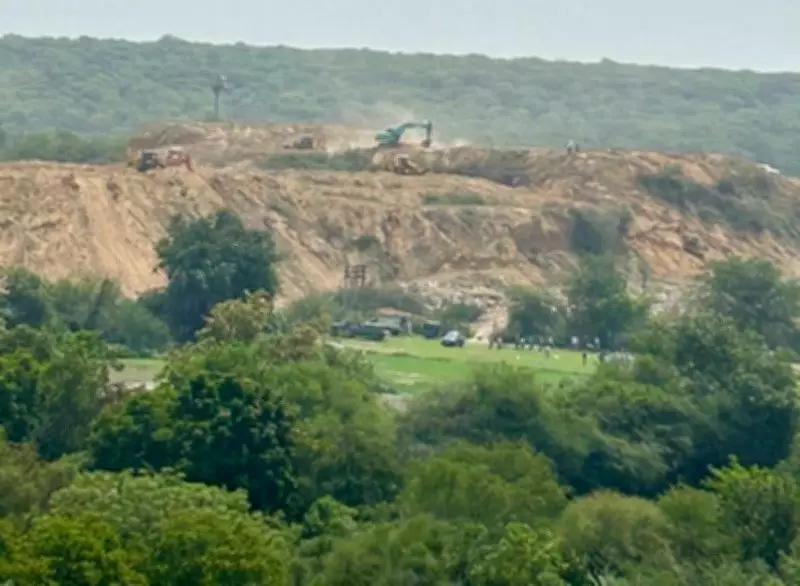
Nearly six months after the Supreme Court reopened the debate over how the Aravalli range should be defined, a group of scientists, environmental policy experts, conservationists, and a retired senior forest officer have written to the Chief Justice of India, questioning whether the court-appointed committee tasked with revisiting the issue is sufficiently independent to do the job.
Concerns Over Committee Composition
In separate representations submitted this week, the experts have challenged the composition of the high-powered committee constituted by the Supreme Court on May 25, 2026. In these letters, experts argue that the panel falls short of the standard set by the court itself when it revisited the matter on December 29, 2025, and called for a "fair, impartial and independent expert opinion."
The intervention comes in a case that has evolved far beyond a technical dispute over maps and hill contours. At its centre is the question of how one of India's oldest mountain systems should be defined and protected, a decision that could influence future mining, conservation, and land-use policies across large parts of Rajasthan, Haryana, Delhi, and Gujarat.

Signatories and Their Arguments
Among those who have written to the Chief Justice are geoscientist and National Institute of Advanced Studies CP Rajendran; scientist and former chairperson of the Supreme Court-appointed Char Dham high-powered committee Ravi Chopra; environmental policy expert Sagar Dhara; retired Principal Chief Conservator of Forests Prakriti Srivastava; and members of conservation networks.
While differing in emphasis, the representations converge on a common concern: that the committee reviewing the earlier process of defining the Aravallis includes officials and institutions linked to the Ministry of Environment, Forest and Climate Change, raising questions about whether the review can be seen as fully independent.
Rajendran said that the present arrangement departed from the spirit of the Supreme Court's intervention. "The composition, as it stands, does not align with the spirit of the December 29, 2025 order, which explicitly called for an independent and fair expert opinion free from executive influence," he wrote, adding that the structure of the committee rendered it "incapable of functioning with the requisite impartiality and independence."
Chopra, drawing on his experience leading a Supreme Court-appointed expert committee, expressed similar concerns. "In both cases it was my disappointing experience that serving and retired government officials and scientists from government-funded institutions on the committees never voted against the views of the government in power, despite orally expressing opinions to the contrary during discussions," he wrote. "Therefore, I have grave doubts about their ability to express written unbiased understanding/opinions on the contested issues," Chopra added.
Broader Ecological Issues Overlooked
The experts have also argued that the debate over the Aravallis has increasingly been reduced to a technical question of hill definition, while broader ecological issues have remained inadequately represented. Their representations point to concerns highlighted during the Supreme Court proceedings, including submissions made by the Amicus Curiae in February 2026. Those submissions argued that the Aravallis should be viewed as a contiguous ecological system rather than solely through the prism of mining regulation. They also revisited earlier court directions asking the Forest Survey of India to map the entire Aravalli range and not restrict the exercise to peaks exceeding a 100-metre threshold.
Some of the experts have also questioned whether all relevant scientific findings were adequately reflected in the process that culminated in the November 2025 judgment, a concern that has prompted calls for a broader examination of the material considered during the proceedings.

Lack of Interdisciplinary Representation
Several signatories contend that the committee lacks representation from disciplines critical to understanding the Aravallis as an ecological landscape. These include hydrology, geology, wildlife conservation, public health, landscape ecology, GIS mapping, and traditional livelihoods. Some signatories have also pointed to the absence of experts with extensive field experience in the Aravalli region.
Framing the issue as one of public confidence, Srivastava wrote, "The Court must not only do the right thing, it must appear to do the right thing."
Urgent Call for Reconsideration
The experts have urged the Supreme Court to reconstitute the committee with independent scientists and specialists from multiple disciplines. They have also sought direct submission of the committee's report to the court, broader consultation with communities affected by mining and environmental degradation, and additional time for the exercise.
They have cited earlier occasions when the Supreme Court and the Union government constituted independent expert bodies to address complex environmental questions. These include committees examining the Char Dham project, waste management issues, the Western Ghats, and other ecologically sensitive regions.
For the signatories, the issue is not merely where the Aravallis begin or end on a map. They argue that a mountain range that influences groundwater recharge, biodiversity conservation, climate resilience, and checking desertification across north-western India requires a review process that is not only scientifically robust but also demonstrably independent.
What began as a dispute over the definition of a hill range has now evolved into a larger debate about environmental governance, scientific credibility, and the manner in which most consequential ecological decisions are made in India.





