The Krishi Vigyan Kendra (KVK) in Kinnaur has been instructed to transform the Kalpa farm into an eco-tourism destination while continuing its role in agricultural education and tourism promotion. Parvinder Sheoran, Zonal Director of the Indian Council of Agricultural Research–Agricultural Technology Application Research Institute (ICAR–ATARI), Zone-I, Ludhiana, issued these directives during a recent visit to the district. He also urged the introduction of additional temperate fruit crops at the farm to bolster its research and demonstration capabilities.
KVK-Kinnaur: A constituent of Dr YS Parmar University
The KVK-Kinnaur operates as a constituent unit of Dr YS Parmar University of Horticulture and Forestry, Nauni, with funding from ICAR. Sheoran reviewed the centre’s ongoing extension, research and development programmes, engaging in detailed discussions with scientists and staff on activity implementation and progress aimed at strengthening agriculture in this tribal district. The KVK team, led by Neena Chauhan, briefed him on achievements, ongoing demonstrations and future plans.
Visit to demonstration farm and VRS Kalpa
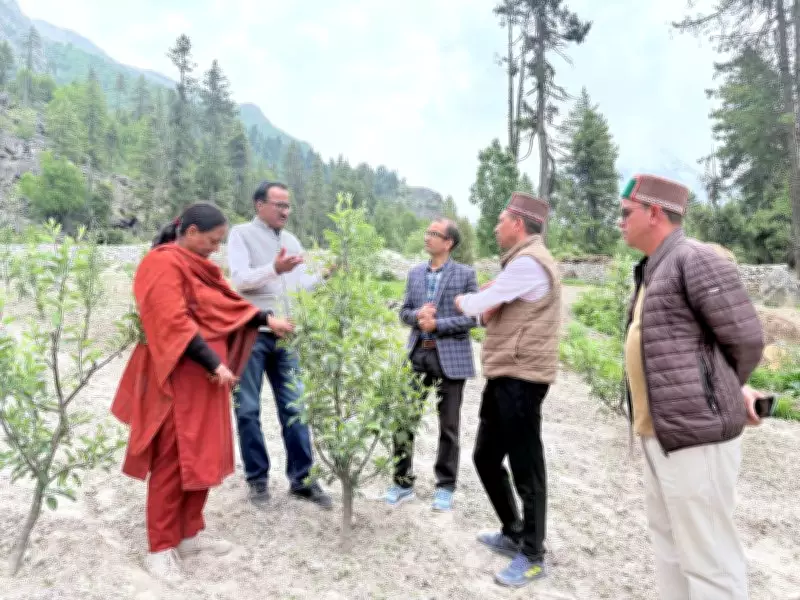
Sheoran toured the KVK Demonstration Farm, the Vegetable Research Station (VRS) at Kalpa, and the Kisan Bhawan at Reckong Peo. At VRS, he examined demonstration trials on high-density apple plantations and seed production of radish, turnip and potato conducted by the Kendra. The station’s work in these areas is expected to provide valuable insights for local farmers.

Farmer-scientist interaction at Chitkul
A farmer-scientist interaction was organised at Chitkul as part of the month-long Khet Bachao Abhiyan. During the session, Sheoran shared information on improved agricultural and horticultural practices. Farmers highlighted the shortage of quality seed and their continued reliance on traditional pea sowing methods as major constraints affecting productivity. Sheoran stressed the need to establish more on-farm demonstration units using quality planting material, enabling farmers to directly observe the benefits of improved production technologies under field conditions.
Tribal Sub Plan projects recommended
The KVK was also advised to formulate and submit suitable projects under the Tribal Sub Plan (TSP), with provisions for distributing quality planting material. This would help tribal farmers adopt improved technologies and strengthen their livelihoods. Sheoran emphasised that such initiatives are crucial for the sustainable development of the region.
High-altitude apple demonstration at Mastrang
As part of the visit, Sheoran inspected a high-altitude demonstration trial of a high-density apple plantation using seedling rootstocks at Mastrang, located at an altitude of 3,450 metres. He reviewed the plantation’s performance under challenging agro-climatic conditions and recommended expanding such demonstrations to farmers’ fields across the district. This would accelerate the adoption of high-density apple orchards and other hi-tech horticultural practices.
Khet Bachao Abhiyan achievements
The visit also included a review of the month-long Khet Bachao Abhiyan, under which the KVK team conducted extensive training and extension activities across all three blocks of Kinnaur district. During the campaign, KVK personnel visited 31 panchayats covering 70 villages, creating awareness among farmers about the latest agricultural and horticultural technologies, integrated crop management, improved production practices and climate-resilient farming to enhance productivity and sustainability in the tribal region.