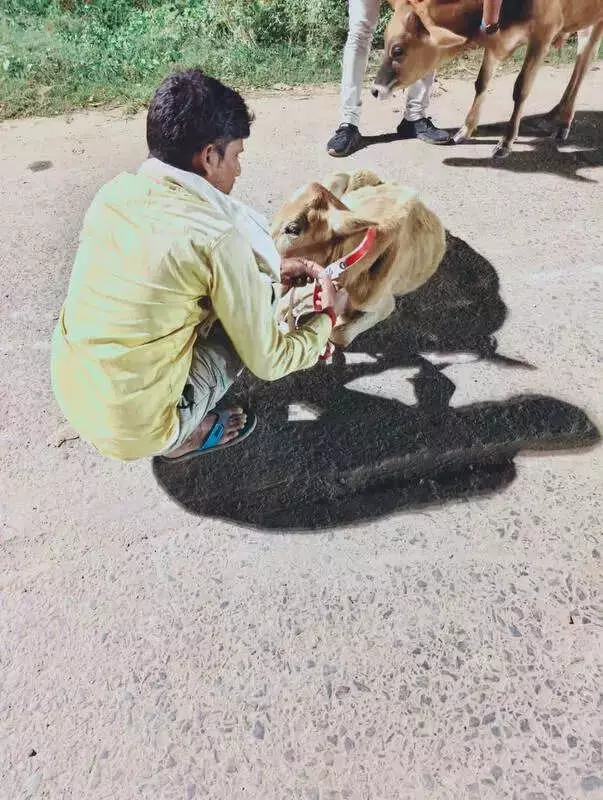
In a novel initiative to enhance road safety, authorities in Kendrapada district have begun fitting stray cattle with special reflective tapes. This measure directly addresses the growing menace of accidents caused by collisions with animals roaming freely on National Highway-53.
High-Visibility Solution for a Persistent Problem
The core of the strategy involves sticking retro-reflective tapes (RRT) on the horns of stray bulls and buffaloes. Recently, a collaborative effort by an NGO, district administration officials, and the Regional Transport Office successfully fitted these tapes on around 100 stray cattle. The radium-based bands are designed to glow in vehicle headlights, making the animals visible from a long distance, which is crucial during night travel and foggy conditions.
Root Causes and Immediate Impact
The problem of stray cattle on highways is largely man-made. Officials note that many cattle are abandoned by their owners once they stop producing milk. These animals then wander onto roads and highways in search of food from nearby villages or garbage dumps. "Many stray cattle sleep in the middle of the highways, leading to traffic problems and accidents," shared Ranjan Tarei, a local motorcyclist.

The transport authorities have set an ambitious target. "We plan to fit the radium strips on around 500 stray cattle in a month," stated Loaknath Meher, the Regional Transport Officer of Kendrapada. He added that a meter of RRT costs between Rs 150 and Rs 200. The initiative has been welcomed by commuters. Bharat Swan, vice-president of the district truck owners' association, expressed his approval of the authorities' step.
Seeking Long-Term and Comprehensive Measures
While the reflective tape is a practical temporary fix, officials and citizens emphasize the need for more permanent solutions. RTO Meher pointed out that it is the duty of the National Highways Authority of India (NHAI) to fence highways to prevent animal entry. He also suggested that panchayats and civic bodies should build animal pounds and shelters and impose fines on negligent owners.
Local shop owner Nirakar Jena from Gop Chhack highlighted a specific hotspot, noting that stray cattle numbers are higher near vegetable markets on both sides of the highways, attracted by garbage dumped by vendors. Furthermore, as motorcyclist Ranjan Tarei observed, the solution has its limits, as it cannot be applied to other nocturnal hazards like stray dogs and jackals, which also pose risks, especially to two-wheeler riders.
The Kendrapada initiative represents a creative, low-tech approach to a complex infrastructure and civic issue, aiming to save both human and animal lives on a busy national highway.