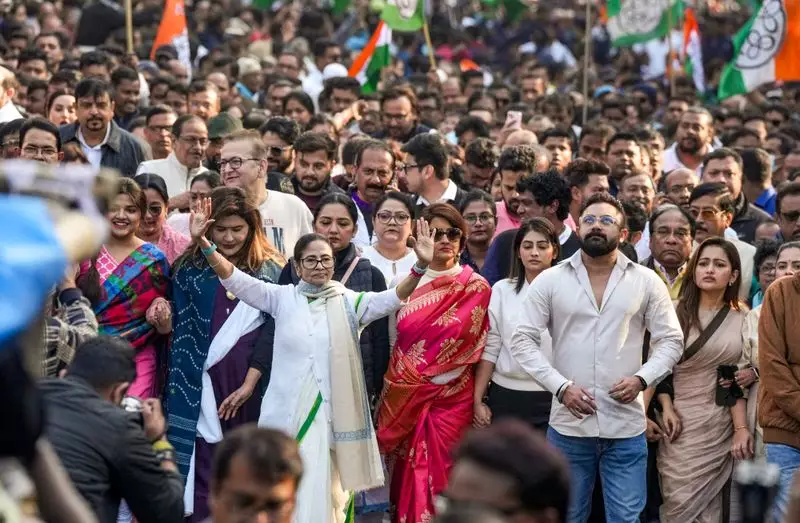
West Bengal Chief Minister Mamata Banerjee took to the streets of Kolkata on Thursday, leading a massive protest march against the Enforcement Directorate (ED). The dramatic public demonstration was a direct response to the central agency's recent actions, including raids connected to the political consultancy firm I-PAC.
A Show of Strength on Kolkata's Streets
The protest, which saw a significant turnout of Trinamool Congress (TMC) leaders, workers, and supporters, began from the party's headquarters on Harish Chatterjee Street. The procession snaked its way through the city's thoroughfares, culminating at the BR Ambedkar statue on Red Road. This public display of dissent is seen as a major political statement by the TMC supremo against the Bharatiya Janata Party (BJP)-led central government.
Banerjee, while addressing the crowd, launched a fierce attack on the BJP, accusing it of using central agencies like the ED to target political opponents. She framed the ED's actions as a politically motivated vendetta aimed at destabilizing her government in West Bengal. The Chief Minister asserted that such tactics would not deter her party and that the people of Bengal stood firmly with the TMC.
The I-PAC Connection and Escalating Tensions
The immediate trigger for the protest was the ED's questioning of an I-PAC employee in Kolkata. I-PAC, or the Indian Political Action Committee, is a well-known political consultancy that has worked closely with the TMC in the past. The agency's probe is reportedly linked to a money laundering case, and its focus on individuals associated with I-PAC has raised political temperatures considerably.
Banerjee vehemently defended I-PAC, stating it was a professional organization. She alleged that the BJP was rattled by the TMC's growing national ambitions and its recent political forays into states like Goa and Tripura. The ED's move is widely perceived as an attempt to find a link between the TMC and the consultancy firm, a claim the ruling party in Bengal has consistently denied.
This incident is not isolated. It follows a pattern of heightened confrontations between the TMC government and central agencies over the past few years. Several high-profile TMC leaders have faced investigations by the ED and the Central Bureau of Investigation (CBI) in various alleged corruption cases.
Political Repercussions and National Narrative
The mega protest march has significant implications for the national political landscape. Firstly, it solidifies Mamata Banerjee's position as a leading voice of opposition against the BJP. By hitting the streets, she has signaled a shift from defensive posturing to aggressive confrontation on the issue of central agency overreach.
Secondly, the event is a powerful tool for mobilizing the TMC's core support base in Bengal. It reinforces the party's narrative of being under constant attack from the Centre, which can resonate strongly with voters. Furthermore, it puts the spotlight back on the contentious issue of federalism and the autonomy of state governments.
The BJP, on its part, has dismissed the protest as a drama to deflect from corruption allegations. Party leaders have maintained that the ED is merely doing its job independently and that the law will take its own course. The clash sets the stage for a bitter and protracted political battle as India moves closer to the next general election.
In conclusion, Mamata Banerjee's leadership of the massive protest march in Kolkata is a defining moment in the ongoing political feud. It underscores the deep rift between the TMC and the BJP-led Centre and highlights the escalating use of investigative agencies as tools of political warfare. The fallout from this public showdown will likely influence political strategies in Bengal and beyond in the coming months.