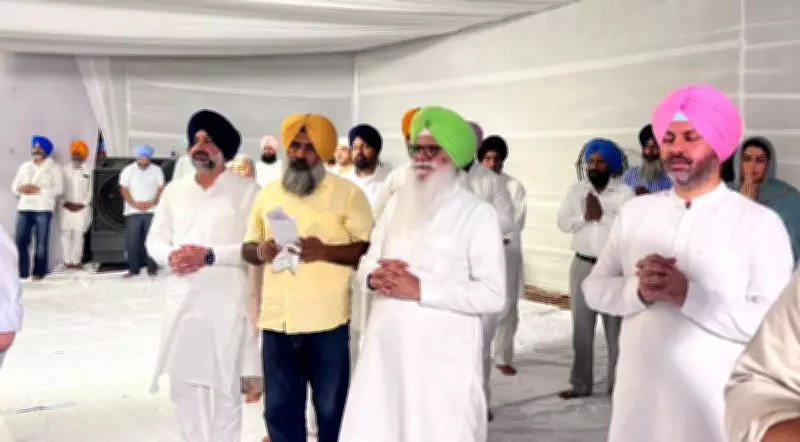
In a significant political development, all 15 Congress MLAs in Punjab, led by Leader of the Opposition Partap Singh Bajwa, appeared before the five Sikh high priests at the Golden Temple complex on Monday. The delegation submitted themselves to the acting Akal Takht Jathedar Giani Kuldeep Singh Gargaj, responding to summons issued over the contentious ‘Jaagat Jot Sri Guru Granth Sahib Satkar (Amendment) Act, 2026’. The move was taken without prior consultation with the Congress party’s central high command, marking a notable departure from party discipline.
MLAs unite without central nod
Bajwa convened a meeting of all party MLAs in Amritsar the previous evening to discuss the Akal Takht summons. “Being the leader of the legislative party, I called a meeting of all MLAs, and everyone agreed to present themselves before the Akal Takht,” Bajwa told The Tribune. The unanimous decision underscores the MLAs’ collective willingness to engage with the supreme temporal authority of the Sikhs, even without approval from the party’s national leadership.
The appearance comes amid a broader restructuring of the Punjab Congress, including the selection of a new state party president. High-level discussions have been held in Delhi over the past few days to finalize the leadership changes. The MLAs’ action is seen as a move to assert their independence and connect with Sikh voters ahead of upcoming elections.

Attack on AAP government
While reaffirming the Congress party’s faith in the Akal Takht, the delegation launched a sharp attack on the ruling Aam Aadmi Party (AAP) government. They alleged that Chief Minister Bhagwant Mann’s administration showed “complete disregard for Sikh principles, traditions, and institutions” by rushing the anti-sacrilege legislation through the Assembly without wider consultations. The Congress leaders accused the government of failing to build a broad Panthic consensus on the emotive issue, claiming it bypassed dialogue with the Sikh community, the Shiromani Gurdwara Parbandhak Committee (SGPC), Sikh scholars, and other key stakeholders.
In a formal letter submitted to the Akal Takht Jathedar, the Congress highlighted several concrete suggestions it had previously submitted to the Assembly’s Select Committee ahead of the special Vidhan Sabha session on April 13. The party criticized the AAP for ignoring these inputs and pushing the legislation unilaterally.
Capitalizing on Panthic vacuum
The Congress has largely stayed away from active Panthic politics in recent years, but the party now appears to be capitalizing on the escalating standoff between the AAP government and the Akal Takht. Senior leaders indicated that the Congress hopes to fill the emerging vacuum in Panthic political leadership and position itself as a credible alternative for Panthic voters. The MLAs’ submission to the Akal Takht is a strategic move to demonstrate their respect for Sikh institutions and attract support from the Sikh electorate.
Former Deputy Chief Minister and Gurdaspur MP Sukhjinder Singh Randhawa, who was part of the delegation, held both the AAP and the BJP responsible for undermining the authority of Sikh institutions. He called upon his party to maintain an aggressive stance to protect their sanctity. Randhawa has also staked his claim for the post of state party president, as has former Chief Minister Charanjit Singh Channi, currently the MP from Jalandhar. The current president, Raja Warring, did not appear before the Takht because he is not an MLA.
Protests and future plans
Just a day prior, on Sunday, Bajwa led a silent sit-in protest near the Town Hall in Amritsar against Chief Minister Bhagwant Mann for allegedly defying the authority of the Akal Takht. Party insiders indicate that more such protests are planned for the coming days. The Congress is expected to continue its aggressive stance against the AAP government on religious issues, aiming to consolidate Sikh votes and challenge the ruling party’s dominance in Punjab.
The development marks a significant shift in Punjab’s political landscape, with the Congress openly embracing Panthic politics to regain lost ground. The party’s ability to balance its traditional secular image with religious outreach will be tested as it navigates the complex dynamics of Sikh identity and governance.