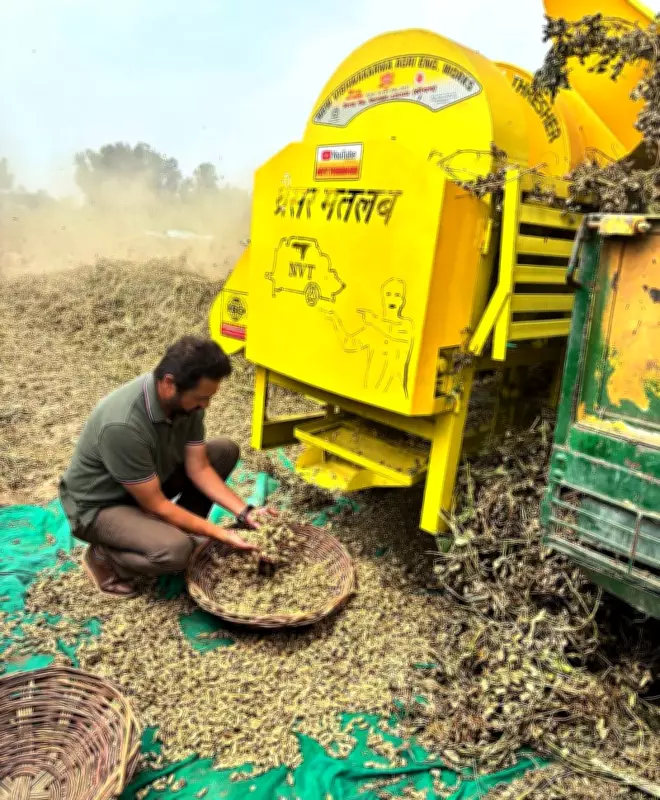
Farmers in Kapurthala district have achieved an impressive average yield of 15–17 quintals per acre with the spring groundnut variety J-87, as demonstrated during a Harvest Day event at village Mothanwalan. The event, organized by Punjab Agricultural University’s Krishi Vigyan Kendra (KVK), Kapurthala, highlighted the crop’s potential as a sustainable alternative to spring/summer maize, requiring significantly less irrigation and offering higher net returns.
Successful cultivation across 70 acres
About 15 progressive farmers cultivated spring groundnut on nearly 70 acres, showcasing the crop’s viability. Dr Mandeep Singh, Assistant Professor (Agronomy) at KVK, Kapurthala, explained that the optimum sowing window is the second fortnight of February, but due to unavoidable circumstances, sowing in farmers’ fields occurred during the first week of March without adversely affecting crop performance. Farmers adopted effective weed management using Stomp (pendimethalin) as a pre-emergence herbicide followed by Imazethapyr 10 SL as a post-emergence herbicide, providing satisfactory and consistent control.
Production technology and yield details
Sowing was done on raised beds using seed planters and pneumatic planters. The groundnut variety J-87 matured in about 115–120 days. After harvesting, the produce was sun-dried for three to four days to ensure smooth threshing. The average yield of 15–17 quintals per acre was recorded, with large heaps of groundnut in the fields serving as visible testimony to the crop’s success.

Farmer experiences and benefits
Progressive farmers shared highly encouraging experiences, highlighting improved profitability, substantial savings in irrigation water, and enhanced soil health. Dr Harinder Singh, In-charge of KVK, Kapurthala, cited the example of progressive farmer Jarnail Singh, who successfully cultivated spring groundnut on 26 acres, clearly demonstrating the crop’s scalability and economic viability. He further pointed out that groundnut, being an environmentally friendly leguminous crop, fixes atmospheric nitrogen through root nodules, enabling farmers to save nearly one to one-and-a-half bags of urea in the succeeding crop.
Impact on crop diversification
The success of spring groundnut cultivation in Kapurthala reflects the growing confidence of farmers in crop diversification initiatives aimed at addressing the serious challenge of rapidly depleting groundwater resources in Punjab. The crop has emerged as a superior alternative to spring/summer maize, reducing input costs and ensuring higher net returns, which motivated many other farmers to adopt spring groundnut in their cropping systems.