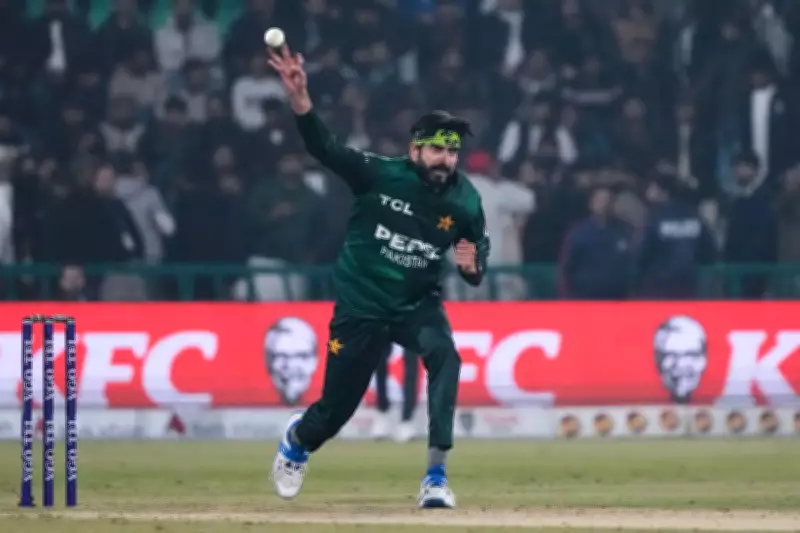
Usman Tariq's Unconventional Bowling Action Dominates T20 World Cup 2026 Discussions
The ICC Twenty20 World Cup 2026 has seen a significant shift in focus towards Pakistan off-spinner Usman Tariq, whose highly unusual bowling action is generating as much debate as it is confusion among batters. The 28-year-old's delivery stride, characterized by a distinct, statue-like pause at the crease before release, has emerged as one of the tournament's most hotly discussed elements. This technique is prompting widespread questions about its legality, its impact on batting rhythm, and the evolving nuances of modern spin bowling in high-stakes cricket.
Controversy and Biomechanical Validation
Usman Tariq's rapid ascent in international cricket has not been without its share of controversy. Critics have pointed to past reports of suspect actions, revisiting cricket's stringent "15-degree elbow flex" rule, which limits how much a bowler's arm can straighten during delivery. Despite being reported twice during the Pakistan Super League, Tariq was officially cleared after undergoing rigorous biomechanical testing at the National Cricket Academy in Lahore. This clearance has added a layer of complexity to the ongoing debate, as his action remains under intense scrutiny from fans and experts alike.
Addressing the persistent concerns, Tariq has consistently defended his technique, attributing it to a natural physical trait. "I have two elbows in my arm… my arm bends naturally. My bent arm is a biological issue," he stated, emphasizing that the scientific testing validated his bowling action. This explanation has done little to quell the doubts, as the visual peculiarity of his pause continues to draw attention on the global stage.

The Disruptive Impact on Batters
What truly sets Usman Tariq apart and unsettles his opponents is the "long pause" in his delivery, which effectively disrupts the timing and concentration of batters. Former Pakistan captain Sarfaraz Ahmed provided insight into this phenomenon, explaining that the momentary halt breaks a batter's focus, rendering even routine deliveries unpredictable. The practical effect has been evident in matches, with prominent players such as Cameron Green and Dewald Brevis visibly perplexed by Tariq's release point and subtle pace variations. This psychological edge has made him a formidable presence in the tournament, turning each delivery into a test of patience and adaptability for the batting side.
Performance Backs the Unorthodox Approach
Despite the ongoing scrutiny and debate, Usman Tariq's on-field results have strongly justified his inclusion in the Pakistan squad. He announced himself on the global stage with a impactful performance, taking three wickets against the United States. His early T20 International record is impressive, highlighted by a hat-trick achieved in Rawalpindi, showcasing his ability to deliver under pressure. As the T20 World Cup 2026 progresses through spin-friendly conditions, Tariq's unconventional action remains both a secret weapon for Pakistan and a central topic in cricket circles worldwide.
Whether viewed as an innovative breakthrough or a contentious issue, his unique biomechanical traits and the signature long pause have ensured that every ball he bowls is watched with a mix of intrigue and suspicion. The discourse surrounding his action reflects broader conversations about the boundaries of cricket rules and the space for individuality in sports.