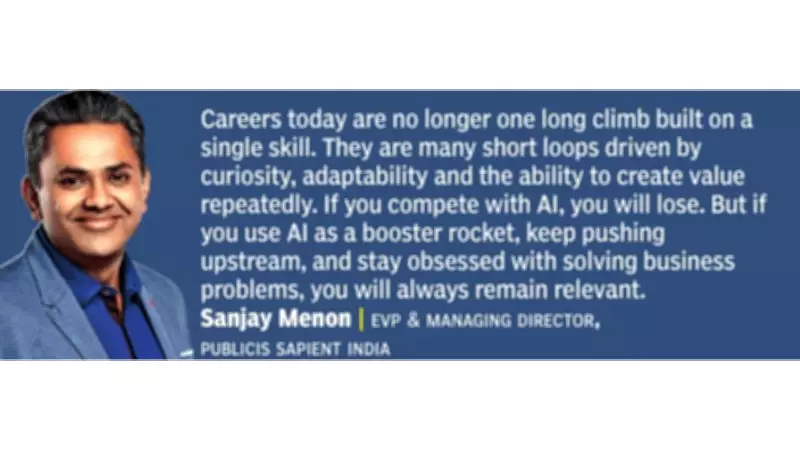
The traditional career, as most have understood it, is dead. Not the working life—that endures—but the old architecture: the single long arc, the carefully chosen specialism, the thirty-year ascent through a recognized hierarchy. Sanjay Menon, executive VP and MD of Publicis Sapient India, wants professionals—particularly young ones—to bury that model and stop mourning it.
The Shift to Short Loops
“In the past, people have thought about careers as one long loop that lasts 25 or 30 years,” Menon says. “You go through a learning curve, a maturing curve, and then a monetization curve. People have to think about careers right now as many short loops.” This idea sounds unsettling, but Menon insists it is liberating—if approached with the right disposition.
Curiosity and the Gamer’s Mindset
Menon argues that the right disposition begins with curiosity and is sustained by what he calls a gamer’s mindset. He observed this while watching his son navigate competitive gaming. “Gamers thrive on the fact that they don’t know enough and they’re being challenged by something that is likely to beat them more often than they will win,” he explains. “It’s the thrill of wanting to be challenged and the joy of overcoming it.” When this spirit is applied to professional life, the paralysis of uncertainty dissolves. Instead of waiting to feel ready, individuals start asking where the opportunity lies.

Menon draws a contrast between dieting and wellness. Dieting is a finite journey—point A to point B—whereas wellness is a continuously evolving set of behaviors oriented toward health. A career, he believes, should follow the wellness model. So how do you think of a career as a set of moves rather than one big move? The answer lies in realizing that expertise is no longer a destination but a series of temporary advantages to be leveraged and then superseded.
Understanding Business Value
For those already embedded in a domain—such as software development or finance—the path forward is not sideways but upstream. Menon uses the example of a developer writing code for an automotive client. “The lowest common denominator is: I’m writing code,” he says. “The next thing is: what am I writing this code for? Why is it valuable for the business?” As AI absorbs the purely mechanical elements of coding, professionals who have pushed their understanding toward business context find themselves already positioned at the next level. “You are building perspective by constantly pushing upstream. Most people look at the work they do as a task; they don’t spend enough time linking that into where it generates business value.”
Red Flags and Relevance Security
Menon suggests that the warning signs of professional obsolescence are subtler than redundancy notices. They appear when colleagues begin treating you as a point solution—summoned for one specific, repeatable task. “To me, that’s a red flag,” he says plainly. “No matter how good we are, we’re never going to be faster or more tireless than a machine. If you compete with AI, you will lose; if you use AI as a booster rocket, you will get where you want to go.” The shift he urges is from job security—which he regards as largely illusory—to what he terms relevance security. “People who stayed in their jobs were always people who were able to create value. Today, you have to create different kinds of value in very short time frames.”
Menon is unsparing about the notion that workers might find refuge by identifying tasks AI cannot yet perform. “A gap that exists today may not exist tomorrow,” he says. The proper response is not to occupy a gap defensively, but to become fluent at identifying gaps—and at scanning laterally for where a skill proven in one sector might become newly valuable in another.

Institutional Implications
The implications for organizations are considerable. Menon advises younger professionals to seek out flat organizations where proximity to business impact is immediate. “If you’re writing code for a shopping cart, you should understand how a single percentage of channel conversion means millions in revenue.” Managers who suppress curiosity—often because their own relevance feels threatened—are not merely bad leaders; they are, in the current climate, genuinely dangerous to the people in their care. “Don’t compromise on what you can create,” Menon advises. “Question the environment you’re in.”