A new generation of Indian mobile gaming companies is creating games for audiences far beyond India's borders. For years, India's role in the global gaming industry was largely that of a consumer. Hundreds of millions of people played games on their smartphones, but few locally developed titles found meaningful commercial success abroad. That is beginning to change.
Today, a growing number of Indian gaming studios are developing products for players in North America, Europe, the Middle East, and Latin America. They are leveraging artificial intelligence, advanced analytics, and global publishing strategies to compete in a market worth over $200 billion, while simultaneously laying the foundations for what many believe will eventually become a significant gaming economy at home.
The reality, however, is that most Indian gaming companies still earn the majority of their revenue overseas.

Monetization Challenges at Home
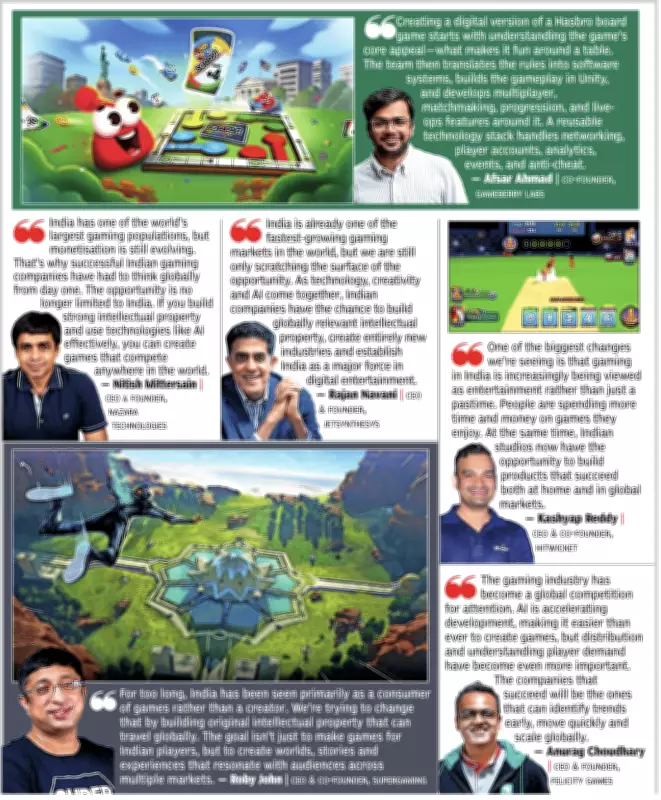
"India has more than 500 million gamers, but monetization remains a challenge," said Nitish Mittersain, founder and chief executive of Nazara Technologies. "Advertising rates are still relatively low, and in-app purchases are only now starting to gain traction. Most successful Indian developers have had to look beyond India and build for global markets."
Nazara is perhaps the clearest example of that strategy. The company has built a portfolio spanning mobile, PC, and console games. Its portfolio includes educational title Kidopia, cricket game World Cricket Championship, and Love Island, based on the popular television franchise. Around 70-80% of its revenue comes from North America and Europe.
"We are building across major platforms, including now Roblox," Mittersain said. "We operate globally, and that diversification has become a key part of our growth strategy."
SuperGaming's Global Reach
The same global outlook is visible at SuperGaming, the Pune-based studio behind multiplayer shooter MaskGun and the India-inspired battle royale title Indus, which is now being positioned internationally as Prime Rush.
Founded by gaming veteran Roby John and his team, SuperGaming has built a reputation for multiplayer technology. MaskGun alone has attracted more than 110 million users worldwide. The company is now preparing to expand further into international markets and bring its games to PC and consoles. Most of its paying users currently come from markets such as the United States, Mexico, and Saudi Arabia.
Gameberry Labs and Hasbro Partnership
Another company proving that Indian studios can build for global audiences is Bengaluru-based Gameberry Labs. Founded in 2017, the company specializes in turning traditional tabletop games into digital experiences. Its portfolio includes multiplayer versions of Ludo, Parcheesi, and Backgammon, games that have attracted players across South Asia, the Middle East, Europe, and the Americas. The company today employs around 350 people, with most of its revenue generated overseas.
Its international ambitions received a major boost when it partnered with Hasbro, the American toy and entertainment giant behind some of the world's most recognizable board game franchises, including Monopoly, Scrabble, Risk, and Cluedo. Gameberry was selected to bring Hasbro's classic board game Sorry! into digital form, transforming a decades-old tabletop experience into a multiplayer mobile game designed for modern audiences.
"Hasbro generally works with gaming companies around the world, but they were impressed by the work we had done on Ludo and Parcheesi," said Afsar Ahmad, co-founder of Gameberry Labs.
The process involves much more than recreating a physical board game on a smartphone screen. Gameberry rebuilds the experience for digital audiences, adding online multiplayer capabilities, social features, and long-term engagement mechanics while preserving the core gameplay that made the original title successful. The company is already working with Hasbro on additional titles.

Felicity Games: Data-Driven Publishing
For newer companies such as Bengaluru-based Felicity Games, success depends less on individual titles and more on identifying global trends before competitors do. Rather than operating as a traditional game studio, Felicity functions as a publisher. It analyzes market data, identifies promising genres, and works with developers to rapidly test new concepts.
Founder and chief executive Anurag Choudhary said the company has evaluated more than 40 games in search of the next breakout hit. "We monitor thousands of games every day," Choudhary said. "We track downloads, rankings, and growth rates to identify genres that are gaining momentum. The goal is to understand where consumer demand is emerging and move quickly."
JetSynthesys: Building Ecosystem Infrastructure
One company with perhaps the broadest view of India's gaming ecosystem is JetSynthesys. Led by entrepreneur Rajan Navani, the company operates across gaming, esports, creator platforms, music, and digital entertainment. It was among the pioneers of esports in India and has played a key role in building some of the infrastructure that supports the country's gaming industry.
Navani argues that India's gaming opportunity extends beyond simply building successful games. It also involves creating the payment systems, creator networks, and competitive ecosystems that allow the industry to flourish. Among JetSynthesys' lesser-known businesses is NovaPlay, which provides payment infrastructure for international gaming platforms. The company also works with Steam, helping global publishers reach Indian consumers through local payment mechanisms and promotions.
"We've seen how much growth can be unlocked simply by making global platforms more accessible to Indian users," Navani said. "When you localize payments and create experiences that fit local consumers, participation increases dramatically."
Domestic Market Inflection Point
While global expansion remains the dominant strategy, several founders believe India's domestic gaming market is finally reaching an important inflection point. Hitwicket offers perhaps the strongest evidence. Founded in Hyderabad by Kashyap Reddy, the company has built a cricket management game that now has more than 20 million users across 100 countries. Unlike most peers, India remains its largest market. Around 65% of users are based in India, while roughly half of the company's revenue comes from Indian players. The game generates revenue entirely through in-app purchases rather than advertising.
"The biggest shift is that people are beginning to spend money on games," Reddy said. "More working professionals are playing regularly and are willing to pay for experiences they enjoy."