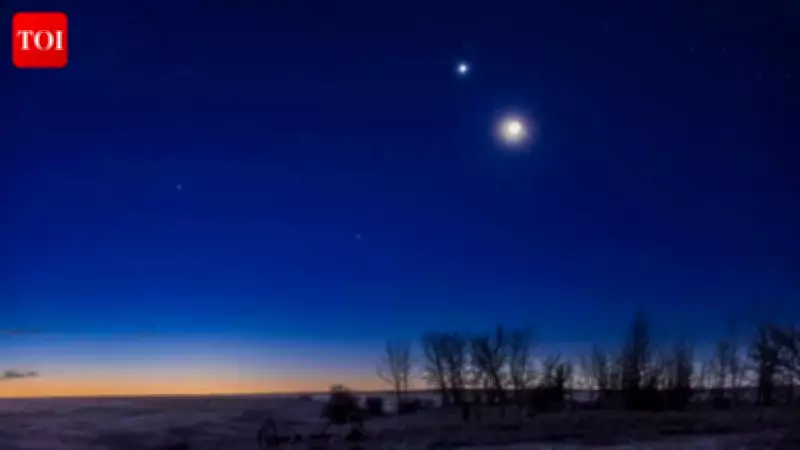
Skywatchers are in for a celestial treat tonight! Look up at the sky after sunset to witness a stunning cosmic gathering. The crescent moon will align with three planets—Venus, Jupiter, and Mercury—in a rare planetary parade visible to the naked eye. No telescope is required; just a clear view of the western horizon and a few minutes outdoors.
What's Happening?
Over the past week, Venus and Jupiter have been drawing closer in the evening sky, while Mercury—usually elusive—has joined the lineup. Now, the crescent moon adds to the arrangement, tying the celestial bodies together. Though they appear close from Earth, each planet is millions of kilometers apart. Their orbits align from our perspective, creating this dazzling display.
Venus shines brilliantly as the "Evening Star." Jupiter, king-sized and bright, sits nearby. Mercury, the trickster, is fainter and closer to the horizon, making it a challenge to spot. The thin crescent moon completes the scene, making it a photographer's delight.

Visibility Around the World
According to Space, the event is visible from North America, South America, Europe, Africa, Asia, and Australia. The best viewing time is 30 to 60 minutes after sunset. Look west—Venus will be the brightest object, Jupiter will shine steadily nearby, Mercury will sit lowest to the horizon, and the Moon will be right beside them.
For optimal viewing, choose a location with a low horizon, such as a rooftop, beach, or open field. City lights may dim Mercury, but Venus and Jupiter are vivid enough to punch through. Rural areas offer the best chance to spot all three planets.
Best Time for Planet Watching
Be outside between 30 and 60 minutes after sunset. This window provides enough darkness to see the planets before they dip below the horizon. Mercury is especially time-sensitive—if you wait too long, it disappears. Venus appears first, followed by Jupiter, with Mercury as the final challenge. The moon will help guide your eyes to the group.
Do You Need a Telescope?
Not at all! Your eyes are sufficient. Binoculars can enhance the view, but avoid using them until the Sun is completely down. Smartphone cameras can capture impressive shots, so don't forget to snap a picture.
Cosmic alignments are not rare, but seeing three planets and a perfect crescent moon so close together is a special occurrence. With Mercury at its best, this is a prime opportunity for skywatchers.
When you step outside tonight, you'll witness a blink-and-you'll-miss-it dance choreographed by the solar system itself!