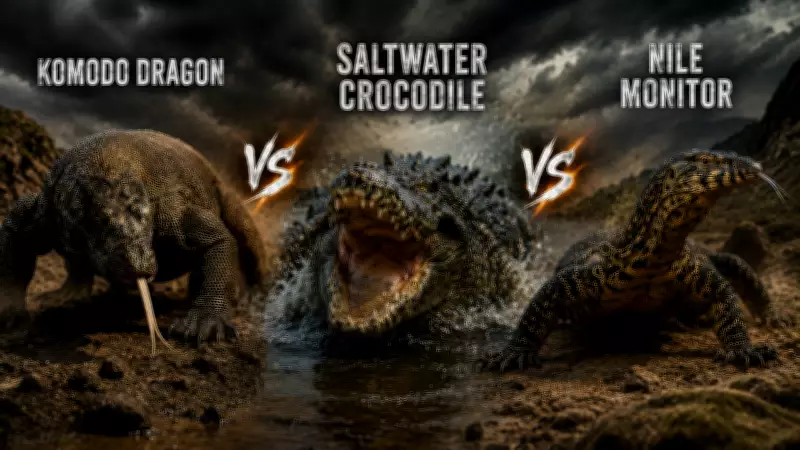
Giant reptiles captivate human attention like few other creatures. The Komodo dragon roams Indonesian islands with a venom-assisted bite and sharp teeth. The saltwater crocodile, the largest living reptile, patrols rivers and coastlines worldwide with immensely powerful jaws. The Nile monitor hunts across Africa with agility and intelligence. Although these three species inhabit different ecosystems and never meet in the wild, comparing their sizes, strengths, hunting techniques, and skills reveals the evolutionary paths that created such impressive predators.
Komodo Dragon vs Saltwater Crocodile vs Nile Monitor: Key Size, Strength, and Predator Comparison
The table below summarizes the critical differences among these reptiles:
- Scientific name: Komodo dragon (Varanus komodoensis), saltwater crocodile (Crocodylus porosus), Nile monitor (Varanus niloticus).
- Maximum length: Komodo dragon reaches around 3 metres; saltwater crocodile exceeds 6 metres; Nile monitor grows up to 2.4 metres.
- Maximum weight: Wild male Komodo dragons can weigh up to 90 kg or more; exceptional male saltwater crocodiles exceed 1,000 kg; Nile monitors reach up to 20 kg.
- Habitat: Komodo dragons live on Indonesian islands; saltwater crocodiles inhabit rivers, estuaries, mangroves, and coasts; Nile monitors are found in rivers, wetlands, and savannahs across Africa.
- Hunting style: Komodo dragons are ambush predators and scavengers; saltwater crocodiles are ambush predators; Nile monitors are active hunters and scavengers.
- Bite force: Komodo dragons have a powerful serrated bite with anticoagulant effects; saltwater crocodiles possess the strongest recorded bite force among living animals; Nile monitors have a strong bite for their size.
- Main prey: Komodo dragons hunt deer, wild pigs, and water buffalo; saltwater crocodiles eat fish, reptiles, birds, and mammals; Nile monitors consume fish, eggs, rodents, birds, and reptiles.
- Conservation status: Komodo dragons are endangered; saltwater crocodiles and Nile monitors are listed as Least Concern by the International Union for Conservation of Nature (IUCN).
According to the IUCN, the Komodo dragon remains endangered due to habitat pressures and climate-related threats, while saltwater crocodiles and Nile monitors maintain more stable populations across much of their range.

Why the Saltwater Crocodile Remains the World's Most Powerful Living Reptile
When raw power is the measure, the saltwater crocodile stands alone. Research titled 'Insights into the Ecology and Evolutionary Success of Crocodilians Revealed through Bite-Force and Tooth-Pressure Experimentation' published by the Department of Biological Science, Florida State University, found that large crocodilians possess the highest bite forces ever measured in a living animal. The strongest recorded individual generated a bite force exceeding 16,000 newtons, enough to crush bone and subdue large prey.
As the researchers noted: "The largest crocodiles generate the highest bite forces ever measured in a living animal." Unlike most predators, saltwater crocodiles rely on patience rather than pursuit. They remain nearly invisible beneath the water's surface before launching explosive attacks. Their success lies not only in strength but also in efficiency. A single ambush can end within seconds. The species can reach lengths exceeding six metres, making it substantially larger than either the Komodo dragon or the Nile monitor. In any direct physical confrontation, the crocodile's immense size, armour-like skin, and extraordinary bite force would provide a decisive advantage.

How the Komodo Dragon and Nile Monitor Evolved into Highly Effective Hunters
The Komodo dragon represents a different evolutionary strategy. Research such as 'Genome of the Komodo dragon reveals adaptations in the cardiovascular and chemosensory systems of monitor lizards' found that Komodo dragons possess venom glands producing proteins that can contribute to shock and blood loss in prey. Combined with deeply serrated teeth, this allows the animal to inflict severe wounds even on much larger mammals. Biologists in the extensive research wrote: "The venom of Varanus komodoensis induces anticoagulation and hypotension." Komodo dragons are also capable of consuming up to 80 per cent of their body weight in a single feeding session, making them among the most formidable terrestrial predators on any island ecosystem.
The Nile monitor, though smaller, should not be underestimated. Studies published by the University of Florida describe Nile monitors as highly adaptable predators capable of exploiting a wide range of food sources. They are strong swimmers, agile climbers, and intelligent foragers. Rather than relying on overwhelming strength, Nile monitors succeed through versatility. They raid nests, hunt fish, capture small vertebrates, and adapt quickly to changing environmental conditions. Across much of Africa, they occupy an ecological role that rewards intelligence and opportunism over brute force.
Which Reptile Would Win in a Predator Showdown?
The answer depends on the category. For sheer power, size, and bite force, the saltwater crocodile is the clear winner. No living reptile rivals its combination of mass and jaw strength. For hunting sophistication on land, the Komodo dragon stands out. Its venom-assisted bite, sensory abilities, and dominance within its island ecosystem make it one of nature's most specialised predators. For adaptability and survival across diverse habitats, the Nile monitor earns recognition. It may lack the size of the other two reptiles, but its intelligence and versatility have helped it thrive across a vast geographic range.
Each species represents a different path to evolutionary success. The crocodile became a powerhouse of aquatic ambush. The Komodo dragon evolved into an apex island hunter. The Nile monitor mastered flexibility. Together, they demonstrate that in nature, there is rarely a single definition of the ultimate predator.