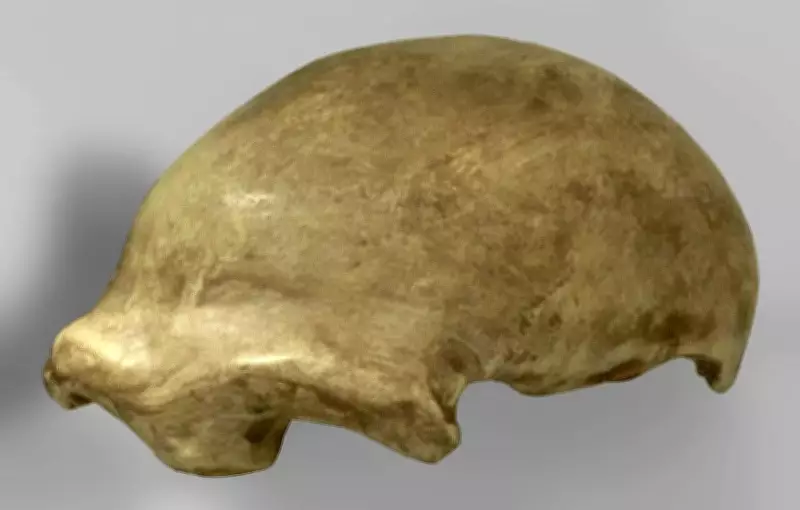
Picture a cave made of limestone, damp and dark, nestled in the Neander Valley in Germany. The year is 1856, and workers are excavating through sediment layers to reach the limestone beneath. Among the heavy bones unearthed is one with a prominent brow ridge. To the laborers, these bones seemed peculiar—perhaps those of a cave bear or a human suffering from a bone condition. Little did they know that they were uncovering evidence of another type of human.
The Revolutionary Discovery of Neanderthal 1
The archaeological dig that led to the discovery of the Neanderthal 1 skull remains is considered a revolutionary development that unfolded slowly over time. During this period, human evolution was still a controversial and debated process. However, researchers managed to demonstrate the existence of evidence of this ancient creature, despite efforts by others to dismiss it. It became clear that this was an artifact from a time when ancient people inhabited the Eurasian region for many millennia.
Redefining Humanity's Place
The importance of this finding cannot be overstated, as it helped reshape humanity's perception of itself. For centuries, humans were believed to be the sole species created by God, existing in isolation from other creatures. According to the overview Who were the Neanderthals? published by the Natural History Museum, the discovery in the Neander Valley proved that the ancestors of contemporary humans were not unique. This discovery transformed the scientific narrative from one of life and death. Neanderthals were not primitive or intellectually inferior, as early cultural depictions suggested. Instead, they were highly developed beings who used fire, cared for their sick, and had larger brains than modern humans. The study of Neanderthal 1 fossils advanced our knowledge of human diversity and common origin, binding all inhabitants of this planet. This discovery challenged prevailing beliefs about human uniqueness, proving Neanderthals were advanced beings who interbred with modern humans.

Unearthing the Concealed Past of Our Genes
Advances in science, from basic microscopes to unlocking the secrets of our genome, make the story of Neanderthal 1 increasingly personal. Instead of viewing them as a type specimen confined to a museum box, we must see them as part of ourselves. Research from the Smithsonian Institution on Homo neanderthalensis highlights that modern genetic findings indicate that when anatomically modern humans left Africa, they encountered and interbred with Neanderthals. As a result, individuals without African ancestry carry 1% to 4% Neanderthal DNA. The story of the lost human becomes even more intriguing in this light. Neanderthals did not simply vanish; they intermixed with Homo sapiens to some extent. The narrative moves from dry archaeology to a humanized story that affects physical traits and well-being today.
A Lasting Legacy
The story of Neanderthal 1 begins with a curious finding by miners in a German quarry. A few bones were enough to revolutionize how scientists view the human family tree. Our ancestry is much richer and more diverse than previously thought. Now, Neanderthal 1 rests in museums worldwide as one of the greatest scientific achievements, proving the existence of ancient cave people. It is amazing to imagine what might have happened if the miners had not been careful; perhaps we would still be waiting to learn about our cousins. One wonders how many other parts of our history remain hidden beneath the burden of time.