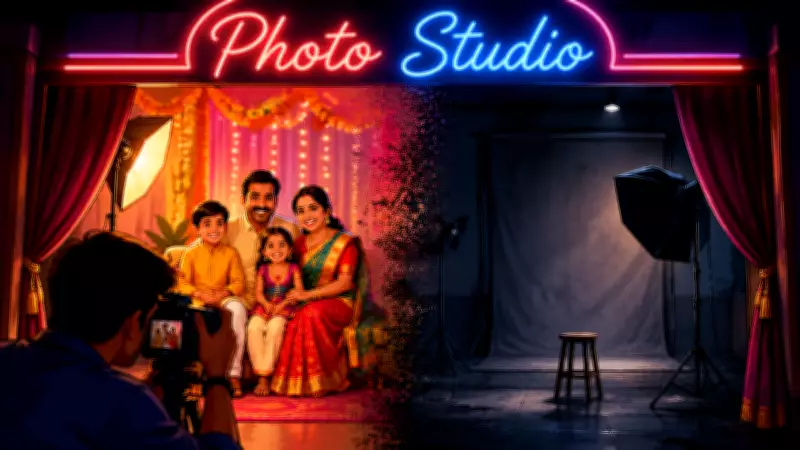
The era of classic studio photos with velvet curtains and soft lighting is fading. Those neighbourhood photo studios, once packed with people seeking the perfect frame, are now struggling to stay afloat. The curious trip to the nearby 'Suresh Photo Studio' has quietly been replaced by the search for that perfect filter.
The Shift from Film to Digital
Photography became common in Indian households in the late 1990s and early 2000s with the advent of digital cameras. Before that, film cameras from Kodak and Agfa dominated, and families relied on studios for important pictures due to the cost of film rolls and developing. Affordable digital cameras from Sony, Canon, and Nikon made photography instant and unlimited. By the 2010s, smartphones from Samsung and Apple made it universal, turning photography into an everyday habit rather than a planned event.
Ironically, Kodak, which invented the digital camera in 1975, failed to adapt and collapsed. Despite knowing digital would replace film, it clung to its traditional business, making weak strategic choices. By the time it tried to adapt, competitors had taken over, making Kodak a classic example of missing a revolution it helped create.

From Long Queues to Silence
Small studios where people patiently waited for a single good picture are now left in eerie silence. The need to capture everything became a habit, and studios are left wondering where they fit in. Navneet Kumar Sharma, a generational photographer with 35 years of experience in Jaipur, recalls the 1990s: 'I would work 16 to 20 hours a day, and even then, the work never seemed to end. Back then, studios were almost always full.' Today, bookings have nearly dried up, even during festivals like Gangaur and Diwali. Now customers only come for passport-size photos.
Romi, a middle-aged photographer, echoes the sentiment: 'We used to think photography was a safe profession because people will always want their photos clicked. But smartphones were basically the AI of that era, taking jobs here and there.' Girdhar, another photographer, was pushed out of his family's studio into a different job. 'I still work with cameras because that's all I knew. The thought of learning something else never really crossed my mind,' he says.
Then vs. Now: A Day in the Life
Sharma describes the current reality: 'Every day looks like a struggle. Unlocking the gates in the morning and then sitting and waiting for customers to walk in.' The footfall is down, and those who come are mostly for passport-size photos, which take five minutes. Earlier, people would come for proper photo sessions with lights, curtains, and props, creating a lively atmosphere. Now, it's just the hope of getting a new order for a birthday, wedding, or corporate event.
Digital Disruption and Other Challenges
Sharma notes that the entire profession has transformed. 'Earlier photography and today's photography are like day and night. There was a standard rate and a standard way of working. But now, with digital, there is no reel cost, everything is stored on cards. It is difficult for photographers to stick to one fixed rate.' He adds that the transition wasn't easy even for those already in the field. 'When technology changed, we old photographers had to adapt. Earlier, people learned the work on the job. Now, there are colleges that offer degrees in photography.'
Romi says with resignation, 'When I first entered this field, days used to feel like moments. Now, it has slowed down a lot. The waiting feels longer than the work itself.' Sharma highlights that most work has moved beyond studios to outdoor locations. 'Customers often tell us that their smartphones take better pictures, and they question our pricing.'
A Profession in Transition
Girdhar reflects on how studio life has nearly faded. 'A day in my life is no longer the same. I have a job now. After I realised earnings were falling, I joined a local news channel as a camera person. I still have the camera skills.'

A Ray of Hope
Despite the challenges, some photographers have adapted. Sharma now relies on outdoor events for livelihood. 'Without weddings and functions, there is hardly any work. Haldi, mehendi, pre-wedding shoots keep things going for a while, but once the season ends, everything goes silent again.' Romi works on regional film projects, which have become a key source of income. 'It's no longer just studio photography. You have to keep moving with the work, otherwise you get left behind.' Girdhar still does outdoor shoots for extra income.
The Bottom Line
The decline of neighbourhood photo studios reflects a larger shift in how society creates and consumes memories. What was once a skilled, time-consuming craft has been replaced by instant, self-driven photography on smartphones. For many studio photographers, the change has meant shrinking incomes, irregular work, and constant pressure to adapt or leave. Yet, their role in shaping visual memory remains significant. Sharma suggests that government support, such as minimum wage protections or skill-based assistance, could help stabilise incomes. These studios now exist on the margins, no longer the first choice, but a quiet reminder of a time when every photograph carried weight, preparation, and permanence.