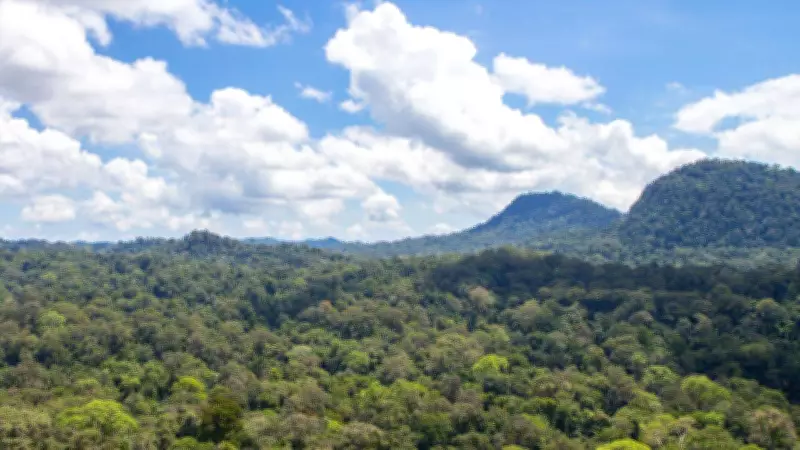
The rainforests of Borneo are often described as some of the richest ecosystems on Earth, yet they continue to produce surprises that have remained hidden for centuries. Among towering trees, dense undergrowth and an extraordinary variety of insects, plants and fungi, scientists have identified a species that occupies a particularly strange place in nature's hierarchy.
The newly described fungus, Pleurocordyceps cornusynnemata, does not simply infect an animal host. Instead, it appears to live by exploiting another fungus already established within that host. This makes it a hyperparasite, a parasite of a parasite. The species was documented during fungal surveys in Malaysia and formally described in a 2026 paper examining members of the genus Pleurocordyceps found in the country's tropical forests. According to the study published in Phytotaxa titled "Taxonomy and phylogeny of Pleurocordyceps (Polycephalomycetaceae, Hypocreales) associated with ants and cicadas from Malaysia, including a new species and new records", the discovery represents the first recorded occurrence of this fungal group in Malaysia and adds a previously unknown species to science.
Discovery of a New Hyperparasite Fungus in Malaysia's Borneo Rainforest
The discovery emerged from fieldwork aimed at exploring fungal diversity in Malaysian rainforests. Researchers collected several fungal specimens associated with insects and other arthropods before examining them through a combination of microscopic analysis and genetic sequencing. Among the collected material was a specimen found on an ant host that did not match any known species. Detailed examination revealed a distinctive structure unlike those previously reported within the genus. The fungus was eventually described as Pleurocordyceps cornusynnemata, with the species name reflecting its unusual horn-shaped reproductive form.

The study published in Phytotaxa notes that the genus Pleurocordyceps already contains species reported from parts of Asia and South America. Malaysia, despite its extensive rainforest ecosystems and recognised fungal richness, had not previously produced documented records of the group. The discovery, therefore, fills an important geographic gap while also expanding the known diversity of the genus itself.
How the New Hyperparasite Fungus Targets Zombie-Ant Fungi
What makes the fungus particularly intriguing is the ecological role associated with members of Pleurocordyceps. These fungi belong to a group known for infecting other organisms that are themselves parasitic or pathogenic.
In this case, the newly described species has been linked to fungi related to the well-known "zombie-ant" fungal complex. Those fungi infect insects and alter their behaviour before eventually killing them and producing reproductive structures from the host's body. The newly identified Pleurocordyceps appears to occupy a higher level in that chain of interactions, feeding on fungal tissue rather than directly manipulating the insect host.
Such relationships remain poorly understood. Rainforest ecosystems contain countless microscopic interactions that rarely attract attention because they occur hidden within soil, vegetation and insect communities. Hyperparasitic fungi represent one of the more complex examples, creating layers of biological dependence that scientists are only beginning to document in detail.
Genetic Evidence Reveals a New Pleurocordyceps Species
Identifying a new fungal species requires more than recognising unusual physical characteristics. The Malaysian team combined traditional morphology with molecular techniques, analysing genetic markers commonly used in fungal taxonomy.
According to the study published in Phytotaxa, two DNA regions, the internal transcribed spacer (ITS) region and the translation elongation factor 1-alpha gene, were examined to determine how the specimens fit within the evolutionary tree of Pleurocordyceps. The resulting phylogenetic analyses confirmed that the ant-associated specimen represented a distinct species rather than a variation of an already known one.

The research also documented two additional Pleurocordyceps species in Malaysia. Together, these findings provide the first baseline information on the group's presence in the country and contribute to a broader understanding of relationships within the fungal family Polycephalomycetaceae, a relatively recently defined branch of fungi.
What This Discovery Reveals About Rainforest Biodiversity
Despite decades of biological research in Borneo, discoveries such as this underline how incomplete scientific knowledge of tropical fungi remains. Large animals and flowering plants are often the most visible components of rainforest biodiversity, but fungal communities represent a vast and largely undocumented portion of these ecosystems.
The authors of the study describe their findings as an expansion of knowledge about the geographic distribution and diversity of Pleurocordyceps. At the same time, the work highlights how many fungal species may still await discovery in Southeast Asia's forests.
For now, Pleurocordyceps cornusynnemata joins a growing catalogue of organisms known only through careful field surveys and laboratory analysis. Hidden inside a web of interactions involving insects and other fungi, it serves as a reminder that some of nature's most unusual relationships are also among its least visible.
About the Author
The TOI Science Desk stands as an inquisitive team of journalists, ceaselessly delving into the realms of discovery to curate a captivating collection of news, features, and articles from the vast and ever-evolving world of science for the readers of The Times of India. Consider us your scientific companion, delivering a daily dose of wonder and enlightenment. Whether it is the intricacies of genetic engineering, the marvels of space exploration, or the latest in artificial intelligence, the TOI Science Desk ensures you stay connected to the pulse of the scientific world. At the TOI Science Desk, we are not just reporters; we are storytellers of scientific narratives. We are committed to demystifying the intricacies of science, making it accessible and engaging for readers of all backgrounds. Join us as we craft knowledge with precision and passion, bringing you on a journey where the mysteries of the universe unfold with every word.