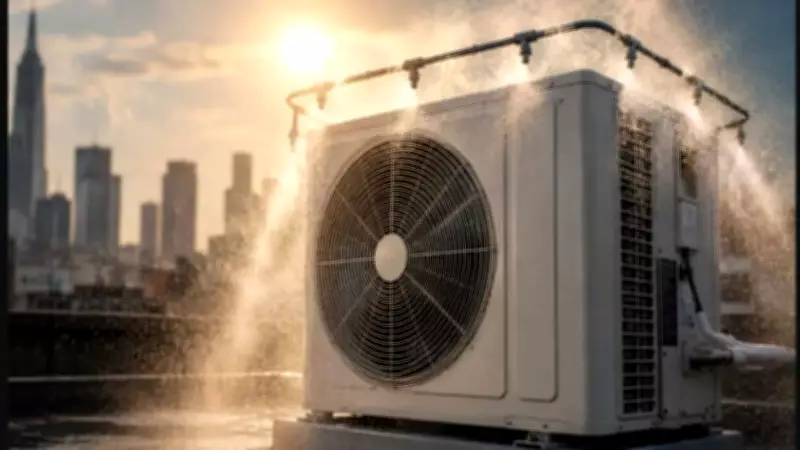
As temperatures continue to soar, people are trying every possible trick to keep their homes cool without facing massive electricity bills. One unusual hack that has recently gone viral on social media involves attaching a water mist system to an air conditioner’s outdoor unit. The idea is simple: spraying fine droplets of water around the condenser may help the AC cool faster and work more efficiently during extreme heat. While the hack looks unconventional, several studies suggest that mist cooling can lower condenser temperatures, reduce compressor workload, and improve energy efficiency in certain weather conditions. Experts say the process works through evaporative cooling, which helps the outdoor unit release heat more effectively and may even reduce overall power consumption.
Can water mist systems improve AC cooling efficiency?
Water mist systems are gaining attention as a possible way to improve the efficiency of air conditioners during extreme summer heat. The concept works through evaporative cooling, where fine droplets of water are sprayed around the AC’s outdoor condenser unit. As the water evaporates, it helps lower the temperature of the air entering the condenser, allowing the system to release heat more effectively.
Several studies suggest that this method can improve cooling performance and reduce electricity consumption under hot and dry conditions. According to a study published in ResearchGate, titled “A Review of Mist Air Evaporative Cooling Systems for Enhanced Refrigeration and Air Conditioning Performance,” water spray cooling improved the coefficient of performance (COP) of split air conditioners by up to 6.16 percent and, in some cases, reduced energy consumption by nearly 40 percent. Another study published in ScienceDirect, titled “Solar-assisted mist cooling system for energy-efficient indoor climate control using hybrid machine learning optimisation,” reported that mist pre-cooling could improve AC efficiency by up to 18.6 percent by reducing condenser temperature and compressor workload. However, experts also warn that the system may not work equally well in humid regions, where evaporation happens more slowly. Long-term use without proper maintenance could also lead to mineral deposits, corrosion, or nozzle blockages.

Does the viral AC hack really reduce electricity bills?
The viral AC cooling hack may help reduce electricity consumption, but experts say the results depend heavily on climate conditions, the type of air conditioner, and how the mist system is installed. The hack works by spraying a fine mist of water around the outdoor condenser unit, which cools the surrounding air before it reaches the condenser coils. This process can reduce the compressor’s workload, allowing the AC to operate more efficiently during extreme heat.
Several studies support the idea that evaporative mist cooling can lower power consumption. According to one study, mist-spray outdoor units reduced total power consumption by around 21 percent compared to conventional outdoor units. Even after including the pump’s electricity usage, the system still reduced overall energy consumption by nearly 16.7 percent. Another study noted that mist cooling systems improved cooling capacity and increased energy efficiency by up to 36 percent under certain environmental conditions. However, researchers also point out that the hack works best in hot and dry weather, where water evaporates quickly. In humid regions, the cooling effect may be weaker because the air already contains high moisture levels. Experts further warn that untreated water can leave mineral deposits on condenser coils over time, potentially causing corrosion or maintenance issues if the system is not cleaned properly.
Is the water mist AC trend worth it?
The viral water mist AC trend has attracted widespread attention online, with many people claiming that it helps air conditioners cool rooms faster while lowering electricity consumption. The idea works by spraying a fine mist of water around the outdoor condenser unit, allowing heat to dissipate more efficiently through evaporative cooling. As the condenser temperature drops, the compressor may not need to work as hard, which can improve the overall efficiency of the air conditioner.

Research also suggests that mist cooling systems can enhance refrigeration and air-conditioning performance under certain conditions. A review published on ResearchGate noted that mist air evaporative cooling systems have shown potential to improve cooling efficiency and reduce energy usage, especially in hot and dry climates. Meanwhile, a study published on ScienceDirect highlighted that evaporative mist cooling can improve thermal performance by lowering condenser temperatures and enhancing heat transfer. However, experts caution that the effectiveness of the system may vary depending on humidity levels, maintenance, and installation quality. In humid weather conditions, the cooling effect may not be as noticeable because evaporation happens more slowly.