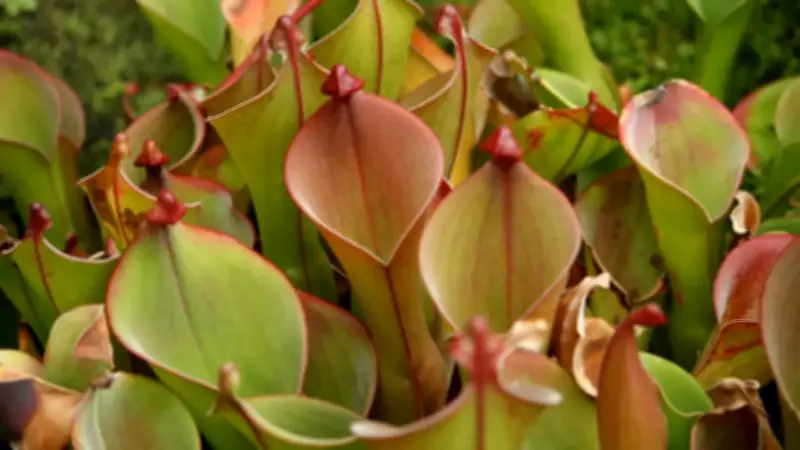
Plants are usually seen as calm, life-giving organisms that rely on sunlight, water and soil to grow. They form the base of most ecosystems and are often associated with nourishment and greenery. However, there are exceptions among plants. In some places, the soil lacks the nutrients plants need to thrive, so certain plants have evolved in surprising ways to survive. These extraordinary species are known as carnivorous plants - plants that trap, kill and digest insects and even small animals to obtain the nutrients they cannot get from the soil. Below are seven such carnivorous plants. Let's take a look!
Venus Flytrap
The Venus flytrap is the most famous carnivorous plant. Its leaf blades work like a snap trap; when an insect touches the sensitive hairs, the leaf closes quickly and holds the prey inside. It mainly eats insects, but sometimes it also catches other very small animals.
Pitcher Plant
Pitcher plants use deep, tube-like leaves filled with liquid. Insects are attracted by nectar, then slip into the pitcher and drown. Some larger pitcher plants, especially in the Nepenthes group, can trap animals such as rodents and other small creatures, not just insects.

Sundew
Sundews have leaves covered with tiny sticky glands that look like drops of dew. These droplets lure insects which then get stuck. The leaf slowly bends around the prey and digests it. Sundews are common in bogs and acidic soils where extra nutrients are hard to find.
Bladderwort
Bladderworts are fast, aquatic carnivorous plants. They use tiny hollow bladders that act like suction traps, pulling in small prey such as insect larvae, water fleas and aquatic worms. Their traps are among the quickest in the plant world, making them especially effective in ponds and wet soils.
Butterwort
Butterworts have soft, sticky leaves that trap very small insects like gnats and fruit flies. Once the insect lands, it sticks to the leaf, which then releases digestive enzymes. These plants are small, delicate and often found in moist habitats where insect prey is easier to catch.
Cobra Lily
The cobra lily, also called the California pitcher plant, has a hooded shape that looks a bit like a raised snake head. Insects are lured inside and then struggle to escape from the slippery trap. It grows in boggy areas of northern California and southern Oregon.
Waterwheel Plant
The waterwheel plant is an aquatic carnivorous plant with tiny underwater traps. It captures small prey such as mosquito larvae and other minute animals. Because it floats freely, it can move with the water while its traps rapidly close around prey. It is a rare and endangered species.
These seven plants show how creative evolution can be. In places where the soil lacks nutrients, they survive by trapping insects and, in some cases, even small animals. Each species uses a different strategy: from snapping jaws to sticky leaves and underwater suction traps.