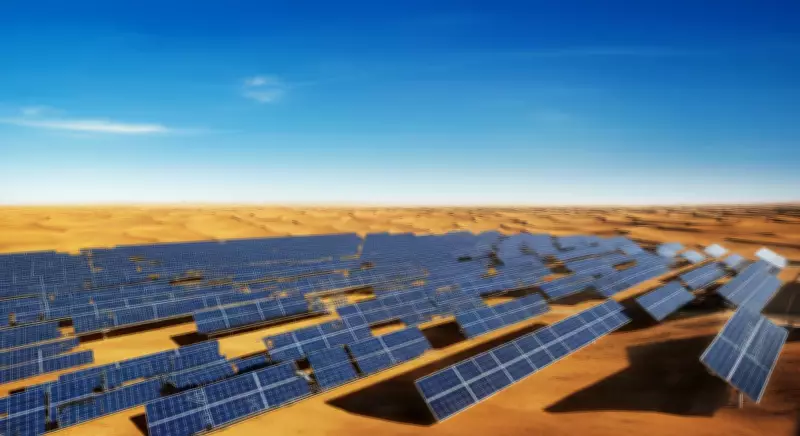
China has constructed what may be the most ambitious solar project in history. Stretching across 400 kilometers of the Kubuqi Desert in Inner Mongolia, a continuous corridor of solar panels now runs three miles wide through what was once a barren wasteland responsible for dust storms that choked Beijing every spring. Visible from space and holding a Guinness World Record, the project is so vast that it already surpasses the total solar capacity of many countries. However, its significance extends beyond sheer size. The panels are also greening the desert beneath them by reducing evaporation, breaking wind, and enabling vegetation to return to land that had been barren for decades. China calls it the Great Solar Wall, and it is only about halfway complete.
What is China's Great Solar Wall in the Kubuqi Desert?
The project, formally named the Kubuqi Desert Ordos Central-Northern New Energy Base, aims to achieve a staggering 100 gigawatts of solar capacity along a single 250-mile corridor. To put that into perspective, India's entire installed solar capacity as of 2024 was around 90 GW. China plans to build more than that in one continuous desert strip. As of 2024, only 5.4 GW was operational, but construction is accelerating rapidly. An additional 7 GW was expected to come online through 2025 alone, with the Three Gorges Kubuqi base—the project's largest single installation—designed to deliver 16 GW when complete, drawing from a mix of solar, wind, and a smaller coal component for grid stabilization.
The project's target output is 40 billion kilowatt-hours of clean electricity per year for the Beijing-Tianjin-Hebei region by the end of this decade. Satellite images captured by the Operational Land Imager on Landsat 8 and Landsat 9, taken seven years apart, already show how aggressively the desert landscape has been transformed.

The Junma Solar Station: A Guinness World Record Shaped Like a Horse
Within the broader corridor lies a completed installation that has made global headlines on its own. The Junma Solar Power Station, meaning "fine horse" in Chinese, is a 2 GW facility comprising over 196,000 solar panels arranged in the shape of a galloping horse large enough to be photographed from orbit. It holds the Guinness World Record for the largest image ever made using solar panels. Built with smart inverter technology developed by Huawei Digital Power, the station generates 2 billion kWh of energy annually while serving as the visual centerpiece of the entire project. The horse image is not merely aesthetic; it is a deliberate cultural signal—the horse is a symbol of strength and freedom in Mongolian culture—and a statement about how China views the relationship between renewable energy and national identity.

Solar Panels as a Tool Against Desertification in Inner Mongolia
What sets this project apart from any other solar farm globally is what is happening beneath the panels. Research published in PNAS examining desert-based photovoltaic development in China found that solar infrastructure in arid regions directly supports desertification control and improves local livelihoods while delivering on climate goals. In the Kubuqi specifically, the effects are already measurable. The panels are mounted higher than standard installations to function as windbreaks, slowing desert winds that previously carried sand hundreds of kilometers toward Beijing. The shade they cast reduces soil evaporation significantly, creating enough moisture retention for grasses and shrubs to take root. A 2026 study published in Ecohydrology that modeled the ecological effects of photovoltaic plants in the Kubuqi found that gross primary productivity increased by 110 grams of carbon per square meter during the growing season compared to the natural desert scenario, alongside a measurable increase in the region's carbon sink capacity. Satellite data has confirmed visible greening in areas where panels have been operational for several years, and researchers are now investigating whether this greening could eventually alter local rainfall patterns over time. According to an analysis published in Scientific Reports on the ecological effects of large-scale photovoltaic development in desert regions, vegetation restoration under solar arrays improves soil structure, stabilizes dunes, and creates measurable biodiversity benefits in areas that previously supported almost no plant life.
The Transmission Challenge: Getting Power from the Desert to the Cities
Generating 100 GW in an uninhabited desert is one challenge; getting it to 100 million people in Beijing, Tianjin, and Hebei, roughly 1,300 kilometers away, is another. This is the project's biggest engineering challenge and has historically slowed China's desert energy ambitions. The solution is ultra-high voltage direct current (UHVDC) transmission. In December 2025, China Daily reported that construction had begun on a dedicated UHVDC line spanning 700 kilometers from western Inner Mongolia to the Beijing-Tianjin-Hebei grid, with a transmission capacity of 8 million kilowatts and an expected operational date of 2027. The $2.4 billion project, operated by State Grid Corporation of China, is specifically designed to carry renewable power from the Kubuqi base southward. Analysis by Dialogue Earth noted that by the end of 2025, China had already commissioned 45 UHVDC lines totaling over 52,000 km of transmission infrastructure—more long-distance high-voltage grid than any other country on Earth.
What China's Solar Wall Means for Global Clean Energy
China's willingness to build at this scale, at this speed, and in such difficult terrain reflects a broader strategic calculation: energy security, climate commitments, and geopolitical influence are all tied together in clean energy infrastructure. While other major economies debate permitting timelines and grid interconnection rules, China is physically moving earth, pouring concrete, and stringing transmission cable across a desert the size of a small European country. The Kubuqi project is not an outlier; it is a template. Similar solar-plus-desertification-control programs are underway at the Tengger Desert in Gansu Province and across the Gobi. China has already restored more than 53% of its treatable desertified land, reducing degraded land area by approximately 4.33 million hectares, according to official government data. The Great Solar Wall is the largest single expression of what that effort looks like when clean energy, land restoration, poverty alleviation, and long-distance transmission infrastructure are all pursued simultaneously rather than one at a time.