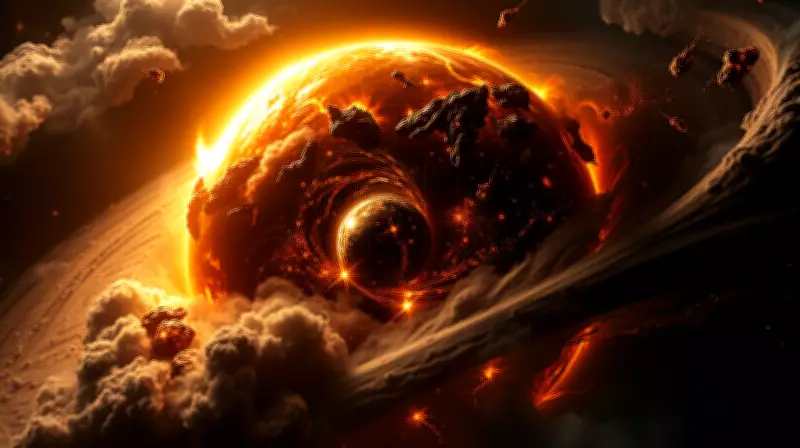
When a massive star runs out of nuclear fuel, physicists have long assumed its fate is sealed: it collapses under its gravity and becomes a black hole. A new theoretical study suggests there may be another, stranger possibility. Physicists Daniel Jampolski and Luciano Rezzolla of Goethe University Frankfurt have developed what they describe as the first dynamic solution to Einstein's equations of general relativity showing how a collapsing star could give birth to a tiny expanding universe instead of a black hole. That miniature universe, driven by dark energy in much the same way our own universe is, would push outward against the star's collapsing matter until the two forces settle into balance, producing an exotic object called a gravastar.
What happens when a massive star runs out of fuel
Stars generate light and heat through nuclear fusion in their cores, a process that produces outward radiation pressure strong enough to balance gravity's relentless inward pull. According to Goethe University Frankfurt's official research statement, this balance holds for as long as a star has fuel left to burn. Once an extremely massive star exhausts that fuel, the outward pressure vanishes, and gravity takes over completely. The star collapses inward, theoretically continuing until its mass is compressed into a single dimensionless point known as a singularity. Conventional physics treats the formation of a black hole as the natural, expected outcome of this process, even though the underlying mathematics of a singularity remains deeply uncomfortable for physicists to work with.
Why black holes raise questions physicists still cannot answer
Even though black holes are widely accepted as the standard outcome of stellar collapse, they leave several fundamental questions unresolved. How can the mass of billions of suns be compressed into a single infinitesimal point? How can spacetime itself become infinitely curved at that point without the known laws of physics breaking down entirely? Black holes also conceal everything that crosses their event horizon, meaning matter, energy, and even light disappear from view the moment they fall in, making it impossible to verify what is actually happening inside. These unresolved puzzles are part of why some theoretical physicists have spent decades searching for alternative objects that could explain the same observations without requiring either a singularity or an event horizon.

What is a gravastar and how is it different from a black hole
One such alternative is the gravastar, short for gravitational vacuum star. According to the study published in Physical Review D, gravastars would be almost as massive and compact as black holes, making them just as difficult to detect given their intense gravitational pull. Unlike a black hole, however, a gravastar would have an outer layer of ordinary matter wrapped around an interior filled entirely with dark energy, the same mysterious form of energy thought to be accelerating the expansion of the universe. That interior dark energy would generate enough outward pressure to permanently counteract gravitational collapse, allowing the object to remain stable without ever forming either a singularity or an event horizon, the two features of black holes that physicists find hardest to explain.
How a mini universe could form inside a collapsing star
The central breakthrough in the new study is a mathematical explanation for how a gravastar could actually form in the first place, a question that has remained unresolved for roughly 25 years. Jampolski and Rezzolla's solution to Einstein's field equations shows that, as a massive star collapses, a small region resembling our own universe's Big Bang could emerge inside the collapsing matter. Lead researcher Daniel Jampolski, who discovered the solution while working on his master's thesis, explained that this miniature Big Bang would only need to occur once the star has already collapsed almost to the point of becoming a black hole. As that embryonic universe expands outward, it counteracts the star's continued collapse until the two opposing forces settle into the stable configuration known as a gravastar.

Why physicists say this doesn't rule out black holes
Rezzolla, a professor of theoretical astrophysics at Goethe University, has been careful to frame the new solution as exploration rather than rejection of established physics. He has said that searching for alternatives to black holes should not be read as scepticism toward black holes, which remain the most natural and simplest outcome of gravitational collapse currently known. At the same time, he has argued that physicists have a responsibility to keep an open mind toward both accepted explanations and more exotic possibilities, since history has repeatedly shown that today's fringe idea can become tomorrow's accepted theory. For now, the gravastar remains a mathematically consistent possibility rather than a confirmed astronomical object, one that future observations of extreme cosmic events may eventually help to test.
This article was originally written by the TOI Science Desk, an inquisitive team of journalists dedicated to demystifying science for readers of The Times of India.