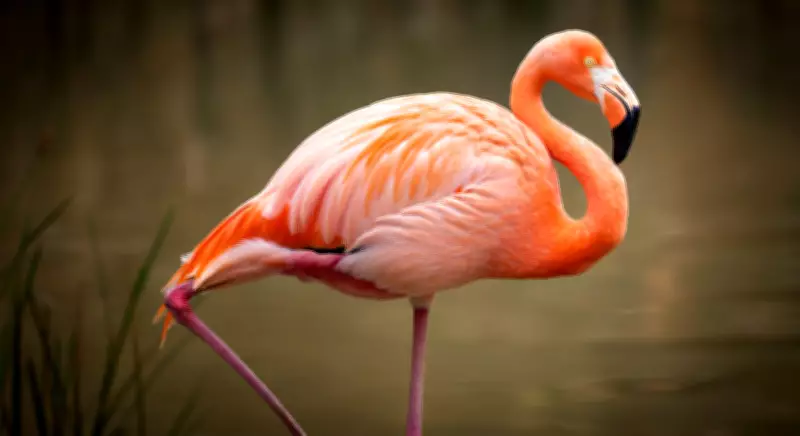
Anyone who has watched a flamingo at a zoo or wetland has likely wondered why the bird balances on a single, spindly leg for hours at a stretch. For decades, this image puzzled biologists, who offered competing explanations ranging from saving body heat to resting tired muscles. Then, in 2017, researchers from the Georgia Institute of Technology and Emory University finally tested the mechanics behind the pose using flamingo cadavers and live birds standing on pressure plates. Their findings showed that flamingos can lock their leg joints into a stable, gravity-assisted position that requires almost no muscular effort to maintain. Combined with earlier research on body temperature, scientists now have a much clearer overall picture of why this unusual stance evolved.
The surprising science behind flamingos' one-legged stance: A built-in mechanism that needs almost no effort
Flamingos (Phoenicopteridae) are famous for tucking one leg beneath their body and standing motionless for hours, often while sleeping. For years, the honest answer given to curious zoo visitors was simply that scientists did not know for certain. Researchers had floated a handful of theories, including the idea that the posture helps flamingos conserve body heat lost through their legs and feet, and the idea that alternating legs reduces muscle fatigue during long resting periods. What made the question difficult to answer was the lack of direct experiments measuring muscle activity or heat loss in the birds themselves. That changed when separate research teams approached the puzzle from two angles, one focused on the bird's skeleton and joints, and the other on its behaviour in different weather conditions.
How a passive 'stay apparatus' helps flamingos balance on one leg
In a 2017 study published in Biology Letters, biomechanics researcher Young-Hui Chang of Georgia Institute of Technology and neuromechanist Lena Ting of Emory University examined how flamingos achieve such effortless balance. Using flamingo cadavers donated by zoos, the pair discovered that a dead bird's leg could be positioned to support its entire body weight on one leg without any muscle activity at all, while the same bird could not be balanced on two legs in the same passive way. The team described this as a gravitational "stay apparatus," a joint configuration that locks the hip and knee into a stable position once the bird shifts its weight over a single leg. Live juvenile flamingos placed on pressure-sensing plates also swayed far less while sleeping on one leg than while awake.

The thermoregulation theory behind flamingos' one-legged stance
While Chang and Ting explained how flamingos balance, an earlier line of research focused on why they might prefer the posture in the first place. In a study published in Zoo Biology, psychologist Matthew Anderson and his colleagues at Saint Joseph's University observed captive Caribbean flamingos across different weather conditions and water exposure. They found that birds were significantly more likely to rest on one leg in cooler temperatures and while standing in water, both situations where heat loss through bare legs and feet is higher. The results pointed strongly toward thermoregulation, since tucking one leg close to the body reduces the surface area exposed to cold water or air, helping the flamingo conserve metabolic heat without expending extra energy.
Why the muscle fatigue theory about flamingos doesn't hold up
One popular theory suggested that flamingos switch legs to avoid tiring out their muscles, in case they needed to flee quickly from a predator. To test this, Anderson's team timed how fast captive flamingos began moving after resting on one leg compared with two. If the fatigue theory were correct, birds resting on a single leg should react faster, since one leg would always stay fresh and ready. Instead, the flamingos took their first steps more quickly when they had been standing on both legs, the opposite of what the muscle fatigue idea predicted. Combined with Chang and Ting's later finding that one-legged standing actually demands less muscular effort than two-legged standing, the evidence now favours energy conservation and thermoregulation over fatigue avoidance as the real drivers of the behaviour.

What flamingos' one-legged balance could mean for robotics and medicine
Beyond solving a long-standing animal behaviour mystery, the discovery of the flamingo's passive stay apparatus has practical implications. Chang has noted that understanding how much of the bird's stability comes from passive anatomy versus active nervous-system control could help engineers design better prosthetic limbs and orthopaedic support devices for people recovering from injury or limb loss. The same principle, building passive stability directly into the mechanical structure rather than relying entirely on sensors and motors, is also being explored in robotics, where machines that can balance with minimal active control would be more energy-efficient and resilient in unpredictable environments. For now, the flamingo's quiet, one-legged pose stands as a reminder that some of nature's simplest-looking behaviours often hide carefully engineered solutions.