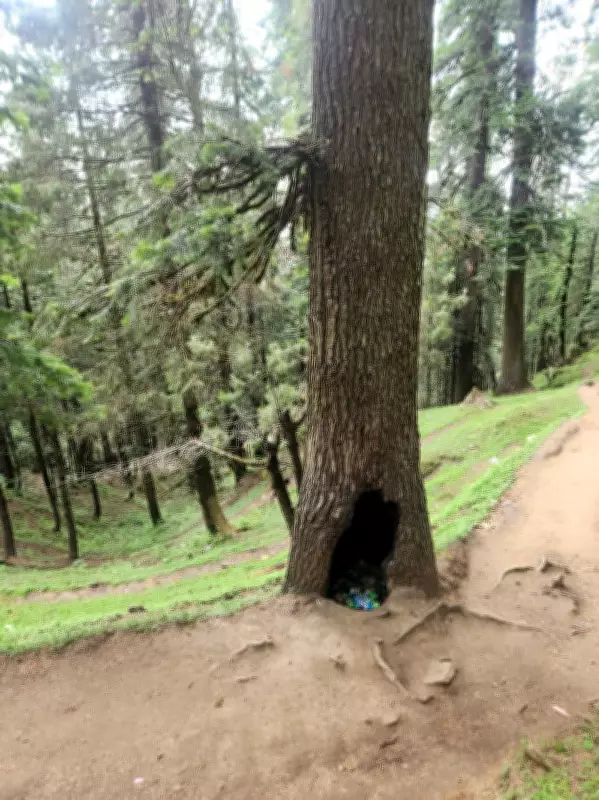
Ancient deodar trees along the Sarain-Churdhar trekking route in Himachal Pradesh are being damaged by littering and burning, with plastic bottles, food wrappers, and disposable packaging stuffed into natural hollows of the trees. Similar incidents have been reported from the Nohradhar trail and other routes leading to the Churdhar shrine, highlighting an alarming pattern of waste disposal in one of the state’s most ecologically sensitive religious landscapes.
Fire Damage Inside Tree Cavities
More disturbingly, some visitors have burnt waste inside the hollow trunks of these centuries-old trees. Unlike open forest fires, flames inside tree cavities remain hidden, slowly charring the wood from within. The damage often goes unnoticed until the tree’s structural integrity is severely compromised. Blackened interiors and fire-scarred cavities visible in several deodars suggest that this silent destruction may have continued for years.
For conservationists, such damage represents far more than the loss of individual trees. A mature Himalayan deodar requires centuries to attain its grandeur. Once weakened or destroyed, it cannot simply be replaced through plantation drives. The ecological, cultural, and historical value accumulated over generations disappears forever, according to environmental experts.

Call for Better Waste Management
The incident has raised questions about environmental management along the pilgrimage routes, especially since the Churdhar Temple Committee receives annual offerings worth crores of rupees. Local residents argue that even a small share of these funds could establish a reliable waste management system with garbage bins, sanitation workers, regular waste collection, and awareness campaigns to discourage littering.
Following complaints, Divisional Forest Officer (Wildlife), Shimla, Dr Shahnawaz Bhat directed his field staff to respond immediately. Wildlife officials, working with local dhaba operators, conducted a cleanliness drive along the affected stretch and removed accumulated plastic waste. The department has also announced plans to organise regular cleanliness drives and install garbage bins at suitable intervals while ensuring that religious sentiments remain respected.
Earlier, Hem Chand Verma, Sub-Divisional Magistrate, Chopal, and Chairman of the Churdhar Temple Committee, acknowledged the issue and assured that corrective measures would be taken.
Conservationists Urge Sustained Action
Yet conservationists believe that periodic clean-up campaigns alone cannot solve the problem. The forests surrounding Churdhar are not merely a scenic backdrop to the shrine; they are an essential part of the pilgrimage itself. Long before devotees bow before the deity, they pass through dense stands of deodar that inspire reverence, humility, and awe. The spiritual experience begins in these forests, not just at the temple.
The broader Churdhar landscape also adjoins the ecologically rich Churdhar Wildlife Sanctuary, home to Himalayan black bears, leopards, barking deer, goral, the Himalayan monal, and numerous other birds and mammals. Plastic waste left by pilgrims threatens this fragile ecosystem through soil and water contamination, accidental ingestion by wildlife, and long-term accumulation of non-biodegradable waste.
Environmental Enthusiast Speaks Out
Mahesh Thakur Maddy, an environmental enthusiast from Lihat village, said, “People visit Churdhar to seek blessings, but some are leaving scars on the forests that make this pilgrimage so special. A deodar that takes centuries to grow can be damaged within hours. Once lost, such heritage cannot be restored through plantation drives alone.”
Residents have urged authorities to introduce stricter enforcement against littering, establish dedicated waste retrieval systems, and encourage every pilgrim to carry back all non-biodegradable waste generated during the trek.

Protecting the Spirit of the Pilgrimage
The deodars lining the Churdhar trails are more than trees. They are living witnesses to centuries of devotion, Himalayan heritage, and ecological resilience. Protecting them is not separate from protecting the pilgrimage—it is central to preserving its spirit. The Wildlife Department’s prompt intervention has offered immediate relief, but safeguarding these ancient forests will ultimately depend on sustained monitoring, effective waste infrastructure, and a shared commitment from every visitor to leave behind only footprints, not plastic.