For years, popular history portrayed Neanderthals as one-dimensional survivalists, focused only on immediate needs and living close to the surface. That view changed after a discovery in a French cave that appears to predate Homo sapiens in Europe by thousands of years.
An Amazing Discovery in Pitch Darkness
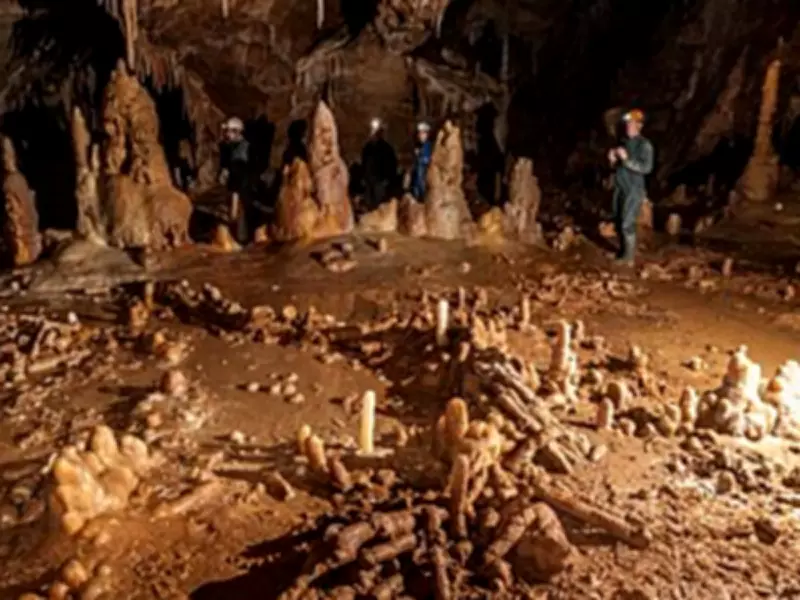
This groundbreaking finding was made at Bruniquel Cave, located in southwestern France. The team traveled 336 metres from the entrance to a completely dark area deep inside the cave complex. Here they discovered two large ring-shaped structures made entirely of broken stalagmites. Along with those mineral formations, there were signs of fire usage. The location mattered because it showed this was not an accidental campsite near the entrance, but a carefully engineered workspace far from natural light. What makes the site even more remarkable is its exceptional state of preservation. This cave was naturally closed in the Pleistocene epoch, thus protecting its interior from any intruders. As a result, the stone rings remained undisturbed for millennia, offering a rare glimpse into the period. Since the cave was preserved through time, the scientists excluded the idea that these objects might have been constructed by another society. It offers a snapshot of an ancient culture and insight into organized underground activity.
The Size That Changed History
The stone rings discovered in the cave are clearly not random piles of stones. The two well-organized circles form a structure; one measures more than five metres in diameter. In order to construct such an object in darkness, a whole crew needed to collect appropriate materials, break the stalagmites and bring them to this very place. It was explained in Nature that the structures presented industrial organization of people who lived at those times. To move through the cave in darkness, the builders would have needed memory and a steady light source. The age of the structures was the most striking finding. Uranium-series dating placed the stalagmite rings at approximately 176,000 years old. The article says the Bruniquel structures were built when Neanderthals were the dominant form of hominins on Earth. Before the Bruniquel discovery, such complex underground construction was widely thought to be unlikely for Neanderthals.

A Trend in a Bigger Picture
The Bruniquel structure was thought of by some critics as an anomaly. Nevertheless, later archaeological discoveries suggested that Neanderthals' interaction with underground structures was more common and advanced than once thought. For example, the earliest clear traces of intentional Neanderthal wall engravings were found at La Roche-Cotard Cave in France. According to a PubMed publication on this research, these wall carvings are estimated to be more than 57,000 years old.
Enduring Mystery of Ancient Times
Although there is clear proof of construction by the rings, there still exists a great mystery surrounding their use. Although burn marks were found around the rings, scientists have not drawn firm conclusions about their purpose. Scientific caution helps keep the findings credible. Whatever their purpose, the rings required considerable effort to build. This suggests disciplined teamwork in a harsh environment. In conclusion, Bruniquel Cave has changed how researchers view Neanderthals. Both the public and scientists may need to reconsider stereotypes about Neanderthals. They were neither helpless cave dwellers nor passive victims of environmental change. Rather, they were capable planners and builders in darkness.