

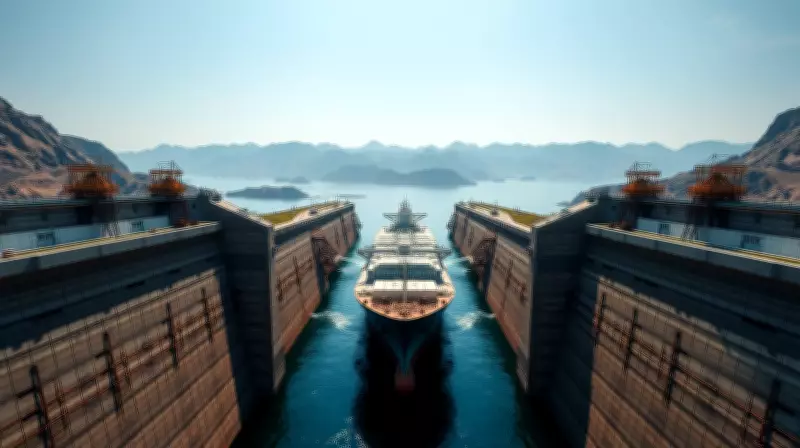
On 8 June 2026, Chinese Vice Premier Ding Xuexiang attended a groundbreaking ceremony in Yichang, Hubei province, formally launching what is expected to be the largest infrastructure undertaking on the Yangtze River in decades. The project, a new mega ship lock system at the Three Gorges Dam costing 77.2 billion yuan (approximately US$11.4 billion), will take an estimated 112 months—just over nine years—to complete. At its core is a five-tier, dual-track series of giant ship locks, structures engineers and officials have dubbed "water staircases" or "water elevators," designed to allow significantly larger vessels to traverse the dam more quickly and in far greater numbers. The goal is to nearly double the dam's annual cargo throughput capacity and relieve a shipping bottleneck so severe that China's Ministry of Transport now openly describes it as a chokepoint threatening the country's internal supply chains.
What Are Ship Locks, and Why Does Three Gorges Urgently Need New Ones?
A ship lock is essentially a controlled water chamber—or a series of chambers—built into or alongside a dam that enables vessels to travel up or down a significant change in water level. When a ship needs to pass through, it enters an enclosed lock chamber; the chamber is then filled with water from the upstream reservoir to raise the ship, or drained to lower it, until the vessel reaches the level of the next river section. A five-tier lock, like the one already operating at Three Gorges and the new one under construction, uses five consecutive chambers to step a ship up or down the full height of the dam, hence the "water staircase" description.
The Three Gorges Dam already operates a five-stage lock and a ship lift, the latter raising vessels all at once in a single mechanical action rather than in steps. Both were designed and built based on shipping projections from the late 1990s. In 2025, the total cargo throughput passing through the Three Gorges Dam reached 173 million tonnes, far exceeding its designed capacity, making it both necessary and urgent to accelerate construction of the new waterway project.

The Scale of the New Three Gorges Ship Lock and Its Engineering Records
The 77.2-billion-yuan project will add a five-tier, dual-track ship lock north of the existing lock at the Three Gorges Dam and upgrade navigation facilities at the smaller downstream Gezhouba Dam. The new ship lock and its approach channels together stretch about 6,680 metres. Each lock line consists of five lock chambers and six lock heads, with individual chambers measuring 280 metres in length and 40 metres in bottom width—dimensions that represent a meaningful step up from the existing lock and will accommodate a new generation of wider inland cargo vessels.
Upon completion, the structure as a whole is expected to become the world's largest inland ship lock. At the downstream Gezhouba Dam, the accompanying upgrade will bring that facility's lock capacity to 360 million tonnes annually. Once the full project is delivered, the Three Gorges Dam will have four lock lines plus the ship lift, with a combined annual throughput capacity of 336 million tonnes—nearly double what the current system can handle.
Why the Yangtze River Is the Backbone of China's Internal Economy
To appreciate what this project is meant to achieve, it helps to understand what the Yangtze River already does for China. The Yangtze River Economic Belt generates more than 40 per cent of the country's total economic output, spans 11 provinces and municipalities, and supports nearly half the nation's population. It is, in effect, the spinal column of China's domestic supply chain—the route along which raw materials, industrial components, and finished goods move between the country's coastal manufacturing hubs and its inland industrial centres.

Shipping on the river flows primarily between Chongqing in the nation's southwest, through the heavy industrial hub of Wuhan in central China, and down to the coastal economic powerhouses of Nanjing and Shanghai in the Yangtze River Delta, where the river empties into the East China Sea. The Three Gorges Dam sits squarely across this route. Every container ship, bulk carrier, and passenger vessel travelling between China's inland and coastal economies must pass through its locks or ship lift. Since 2003, the volume of traffic has grown far beyond what the original infrastructure was designed to handle.
The Chokepoint Problem That Made a Nine-Year, $11 Billion Project Unavoidable
"The old Three Gorges locks and ship lift have become a chokepoint," officials with China's Ministry of Transport were quoted as saying by Xinhua. "Even the boldest planning decades ago failed to anticipate the huge rise in passengers and cargo flows along the Yangtze today." The consequences are tangible and measurable. Vessels waiting to pass through the existing locks have faced extended queuing times, raising logistics costs for manufacturers and traders dependent on the river. For a ship captain who has spent two decades on the Yangtze, the calculus is straightforward: "With the new waterway, companies would spend less on delays, and we could get home earlier," said Jiang Zhongjin, a container ship captain quoted by CGTN.
The congestion problem has deepened as China's industrial base expanded along the river corridor in the two decades since the dam's lock system became operational. A growing number of larger vessels carrying bigger loads of coal, iron ore, construction materials, and consumer goods now compete for passage through infrastructure designed for a smaller, slower era of Yangtze shipping.
Environmental Considerations That Added 2 Billion Yuan to the Project Cost
The project did not proceed without acknowledging its environmental footprint. The Yangtze River is home to several critically endangered species, most notably the Chinese sturgeon, a prehistoric fish whose spawning grounds have already been significantly disrupted by the original dam. To avoid affecting the sturgeon's spawning grounds, China's engineers revised the original lock design—a change that raised the overall project cost by 2 billion yuan, according to Gao Peng, deputy chief engineer of the China Three Gorges Corporation. The revision reflects commitments under China's Yangtze River Protection Law, which came into force in 2021 and introduced stricter rules on development activities along the river corridor.
The Three Gorges Dam was one of the largest infrastructure projects in human history when it was built. It is now a bottleneck. That is not a failure of engineering—it is what happens when an economy grows faster than anyone dared to project. The new lock is not a correction. It is a consequence.





