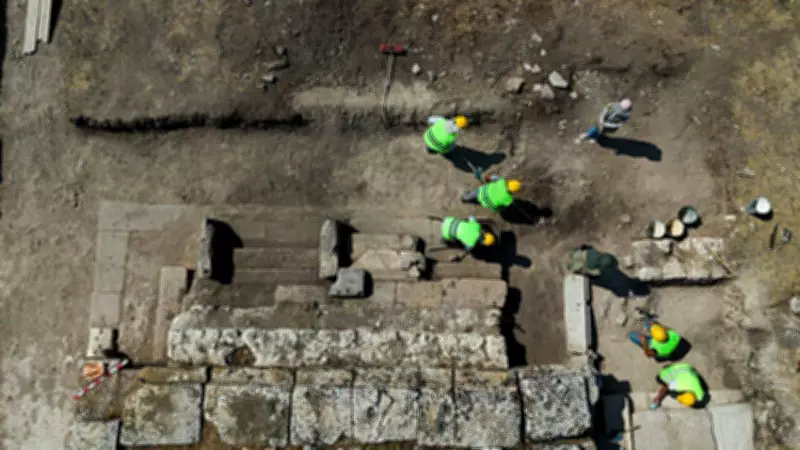
Archaeological work at the ancient city of Blaundos in western Türkiye is offering a closer look at how sacred spaces functioned nearly two millennia ago. Excavations are currently focused on a secluded section of the city's North Temple, where archaeologists are investigating an area believed to have been reserved for religious activity and access by temple officials.
The discovery forms part of a broader effort to understand Blaundos, an ancient settlement perched above deep valleys in present-day Uşak Province. The excavations conducted across the site in recent years have gradually revealed new details about its urban layout, religious buildings and long occupation history.
Ancient city of Blaundos: The fortified settlement linked to Alexander the Great
Blaundos occupies a naturally defensible position on a plateau overlooking the dramatic landscape of the Ulubey Canyon. Historical evidence suggests the city was established by Macedonian settlers following the campaigns of Alexander the Great and later developed under Hellenistic, Roman and Byzantine rule.

In a report published during the 2025 excavation season, Anatolian Archaeology described Blaundos as a strategic military colony situated between the historical regions of Lydia and Phrygia. The city eventually grew into an important urban centre, containing temples, public streets, a stadium, aqueducts and extensive burial areas. Its location remains one of its most distinctive features. Deep valleys surround much of the site, while access was largely controlled through a fortified northern entrance.
North Temple at Blaundos reveals a sacred area hidden for nearly 1,900 years
One of the most significant discoveries made at Blaundos in recent years has been the identification of the North Temple. As reported in September 2025, the structure dates to roughly 1,900 years ago and was constructed on a substantial raised podium near the city's main gate.
The temple attracted attention not only because of its size but also because of indications that it remained important long after its original construction. Archaeologists found evidence suggesting that the complex continued to be used during the Byzantine period, reflecting changing religious traditions within the region.
Current excavation work has shifted towards an enclosed sacred zone associated with the temple. Such spaces often served as restricted areas where rituals, offerings and ceremonial activities took place away from the wider public.
How the North Temple survived changing faiths in ancient Blaundos
Blaundos presents archaeologists with an unusual opportunity to study how sacred sites evolved. Reportedly, the discovery of carved crosses on marble blocks linked to the North Temple suggests that the structure remained part of the religious landscape during the Christian era.
Rather than abandoning older monuments, later communities frequently adapted them for new purposes. This pattern can be seen across many parts of Anatolia, where Roman religious buildings were modified and reused over centuries.
At Blaundos, traces of those transitions appear to survive within the same architectural complex, creating a layered record of belief systems that changed while the physical setting endured.
Excavations at Blaundos uncover layers of Hellenistic, Roman and Byzantine history
The excavation is also revealing the challenges of working within a site occupied by successive civilisations. Byzantine remains often sit above Roman structures, while older Hellenistic layers remain buried beneath them.
Archaeologists are continuing to investigate several parts of the city simultaneously, including public avenues and civic structures alongside religious monuments.