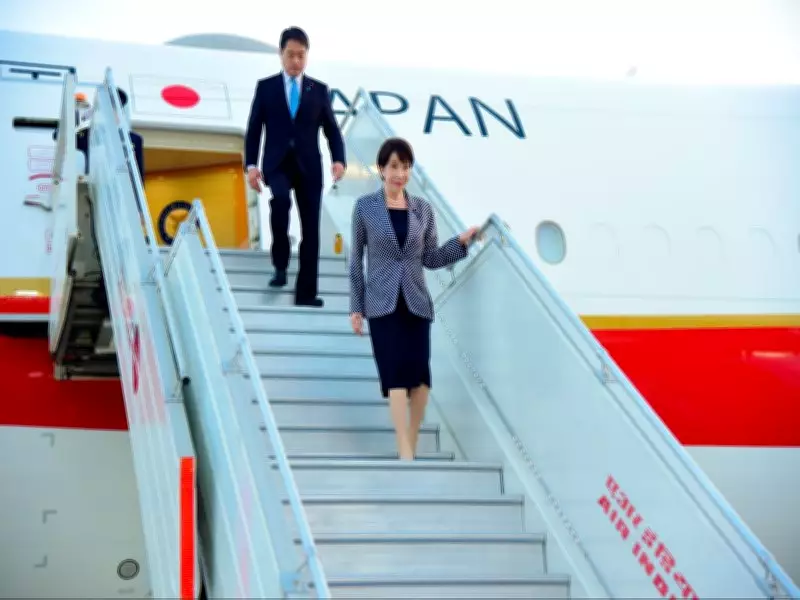
Japanese Prime Minister Sanae Takaichi arrived in New Delhi on Wednesday evening for a three-day official visit to India, where she will participate in the 16th India-Japan Annual Summit. The visit, from July 1 to July 3, marks Takaichi's first official trip to India since assuming office, at the invitation of Prime Minister Narendra Modi.
Upon her arrival at the airport, Takaichi was received by Minister of State for Science and Technology Jitendra Singh. The Ministry of External Affairs (MEA) Spokesperson Randhir Jaiswal welcomed the Japanese PM on X, stating that the visit marks an important step in advancing the Special Strategic and Global Partnership between India and Japan.
Focus Areas of the Summit
The annual summit is expected to deepen cooperation in economic security, resilient supply chains, emerging technologies, defence, maritime security, and investment. Both countries will review the full spectrum of bilateral cooperation and exchange views on regional and global developments of mutual interest, according to the MEA.

Ahead of her departure from Tokyo, Takaichi emphasized the growing importance of India in Japan's foreign policy. "Amid growing uncertainty in the international situation, the importance of collaboration with India, which shares fundamental values and strategic interests, is only increasing," she said during an informal press conference.
Strategic Cooperation and Economic Security
Takaichi stated that her discussions with Prime Minister Modi would center on three key points: deepening the strategic cooperative relationship, promoting cooperation in economic security, and fostering collaboration between companies toward investment and innovation. She also highlighted the role of the private sector, noting that more than 150 representatives from Japan's business community are expected to participate in the India-Japan Economic Forum.
"By uniting government and private sectors, we aim to broaden the scope of Japan-India cooperation and realise a strong economy," she added.
Indo-Pacific and Regional Security
Regional security, particularly in the context of the Indo-Pacific, will feature prominently in the discussions. Takaichi said, "India, like Japan, as a major democratic country in Asia, bears responsibility for achieving peace and stability in the Indo-Pacific region. I intend to firmly discuss with Prime Minister Modi efforts toward realising a 'Free and Open Indo-Pacific' (FOIP), including the framework of Japan, the United States, Australia, and India."
She also expressed confidence in strengthening her personal rapport with Prime Minister Modi, viewing the visit as an opportunity to deepen mutual trust.
Expected Outcomes and Agreements
Diplomatic sources indicated that the summit is expected to produce a Joint Statement reaffirming the strategic partnership, along with agreements and memoranda of understanding in artificial intelligence, pharmaceuticals, batteries, critical minerals, and energy resilience. Investment and innovation will be central themes, with particular emphasis on semiconductors, critical minerals, and economic security.
Maritime security and defence technology cooperation are also expected to receive considerable attention. Officials said the two countries are exploring the development of an "Industrial Value Chain" connecting the Bay of Bengal with India's Northeast, integrating infrastructure development with regional connectivity and manufacturing.
Continuation of Previous Momentum
The summit builds on the momentum from Prime Minister Modi's visit to Tokyo in August 2025 for the 15th India-Japan Annual Summit, where the two countries adopted a Joint Vision for the Next Decade and a Joint Declaration on Security Cooperation. They also launched the India-Japan Economic Security Initiative to deepen collaboration in resilient supply chains and critical technologies, including semiconductors, telecommunications, pharmaceuticals, clean energy, and critical minerals.
Another outcome of the previous summit was the Action Plan for India-Japan Human Resource Exchange and Cooperation, which aims to exchange more than 500,000 personnel over five years, including 50,000 skilled professionals from India to Japan.

Prime Minister Modi and Prime Minister Takaichi also interacted on the sidelines of the G7 Summit last month, reaffirming their commitment to expanding economic cooperation with a focus on trade and investment.