Nashik: In the interiors of north Maharashtra's Peth taluka, a quiet but powerful transformation is taking root, one that smells of jasmine and signals dignity. Backed by assured water access, nearly 75% of tribal families have broken free from the harsh, decades-old cycle of post-Diwali migration, choosing instead to stay, cultivate, and thrive on their own land.
Ending a Cycle of Distress Migration
For generations, villages such as Gaydhond, Garmal, Adgaon, and Bhuvan, located along the Gujarat border, emptied out each winter. With fields running dry, families were forced to leave behind their homes in search of daily-wage work in Nashik's industrial belts or the agricultural hubs of Niphad, Dindori, and even Surat in Gujarat. They would return only with the monsoon, for another uncertain farming season. That rhythm of distress migration is now steadily fading.
Community-Led Water Conservation Model
Driving this change is a community-led water conservation model facilitated by Swades Foundation, one that has ownership, discipline, and sustainability at its core. “We act as a catalyst for community-driven change,” said Tushar Inamdar, the deputy director of Swades. “Villagers have to earn these farm ponds. We interact with them to ensure everyone is ready to contribute to cleanliness, focus on health, and work together for the village's overall prosperity. Once a village demonstrates this collective commitment, the Swades Foundation helps construct either individual or community-based farm ponds.”

Infrastructure with Accountability
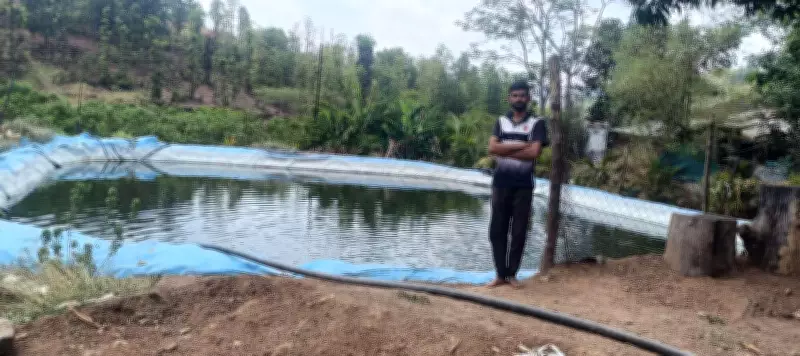
The model combines infrastructure with accountability. In Belpada, for instance, three farmers share a 30x30m pond that stores nearly 30 lakh litres of harvested rainwater or river water (not water extracted from overused wells). The system runs on solar pumps and strict usage rules. “We have 30 lakh litre of rainwater or river water harvested here using solar pumps provided to us,” said farmer Haridas Bhusare. “The rules are strict. Water must only be used through drip irrigation, and we all use it in fixed quantities on a tight time rotation.” Despite water availability being assured only until March, farmers have learned to stretch it skillfully through May, reflecting disciplined water literacy and collective management.
Visible Results in Fields and Lives
The results are visible across fields, and in lives. Twenty-four-year-old Vinayak Raut is among many whose paths have changed. “During the rainy season, we cultivate paddy. After Diwali, we used to migrate because of the water scarcity. The farm ponds have changed everything for us,” he said. “With consistent water, farmers are now successfully harvesting second, and even third crops each year. The agricultural output has spiked dramatically.” In Garmal, farmer Eknath Dalvi has seen his tomato yield jump fourfold — from 40 quintals to 160 quintals in a season — signalling how water access is directly translating into income security.
Jasmine Cultivation Blooms in Gaydhond
But perhaps the most vivid transformation is unfolding in Gaydhond, now blooming as a hub of mogra (jasmine) cultivation. Introduced in 2017 by farmer Laxman Khurkute, the delicate crop once struggled because of heat and water scarcity. Today, powered by farm ponds, more than 90 farmers cultivate mogra successfully. “From Nov till May, when mogra flowering is at its peak, everyone is busy from 7am packing and transporting buds to Nashik,” said farmer Vishwanath Bhusare. “Because we face a shortage of hands, we actually pool our workers to help each other out. Currently, the region produces 120kg of mogra daily, accounting to 60% of the Nashik market.”
Social and Economic Transformation
The shift is not just agricultural. It is social and economic. Villagers who once migrated in distress are now rural entrepreneurs, collaborating, diversifying, and planning. Many are preparing to expand into chafa (frangipani) cultivation and explore direct market linkages in Mumbai, bypassing middlemen. From migration corridors to blooming fields, Peth's story is one of resilience nurtured by water, community, and vision — where the fragrance of mogra now marks not just a crop, but a future reclaimed.