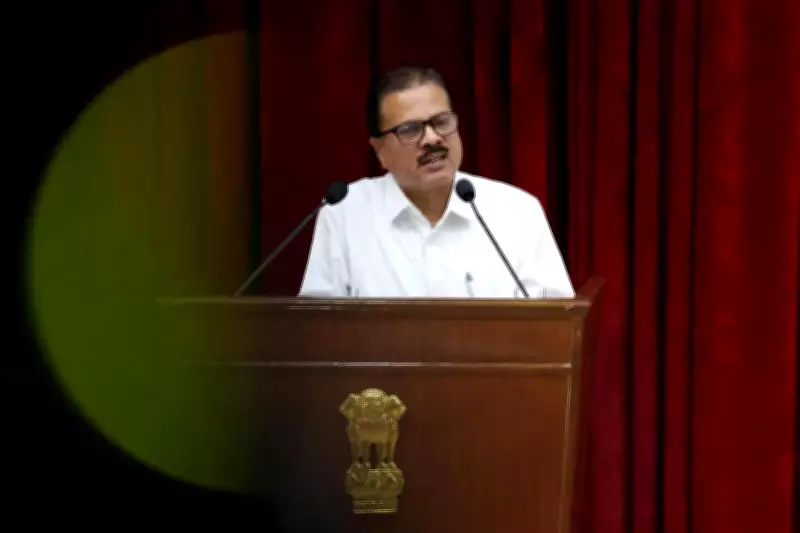
In Puri, during the BRICS technical meeting of the Disaster Risk Reduction Group, India Meteorological Department (IMD) Director General Mrutyunjay Mohapatra spoke to Ashok Pradhan and Hemanta Pradhan about the critical need for seamless global data sharing to mitigate disasters. Excerpts:
Scope for a BRICS-Level Climate Information-Sharing Platform
Disasters, especially weather-related ones, do not respect borders. Effective early warning requires cross-country collaboration. BRICS nations share common challenges and comparable capacities in science, technology, and early warning systems. This platform can enable exchange of data, expertise, and best practices across preparedness, mitigation, and response. With climate change increasing the frequency and intensity of extreme events, pooling resources and knowledge is critical for improving forecasts and reducing impact.
Diverse Challenges Faced by BRICS Nations
Many BRICS countries face similar hazards — floods, droughts, heatwaves, and intense rainfall. Sharing data and experience helps refine responses. All are part of the World Meteorological Organization, which already facilitates data exchange. This can be strengthened further. Data is now central to both physical and artificial intelligence (AI)-driven forecasting models. Comparing performance across regions, identifying gaps, and sharing lessons will improve early warning systems in all member countries.

How BRICS Nations Can Collaborate More Effectively
Collaboration should focus on observations and prediction. Satellite data — from geostationary and polar-orbiting systems — can be shared through global platforms like The Coordination Group for Meteorological Satellites. On prediction, countries run global models that can be accessed and evaluated collectively. Sharing real-time observations and model outputs will improve accuracy and consistency in forecasting across regions.
Projection on El Niño
Models indicate over 90% probability of El Niño conditions during June-September. It is likely to begin as weak and strengthen to moderate levels, possibly intensifying further by September. El Niño can affect rainfall patterns, and IMD has factored this into its monsoon forecast. For 2026, rainfall is projected to be below normal at about 90% of the long-period average.
Lessons from India’s Early Warning System Amid Rapid Urbanisation
India has strengthened its early warning framework with a "Har har mausam, har ghar mausam" weather forecast, aiming to reach every household. The Mausam app provides hyperlocal forecasts. India also uses impact-based forecasting and the Common Alerting Protocol — both still evolving globally. Urban flood management systems are operational in cities like Mumbai, Chennai, and Kolkata, and expanding to Delhi, Pune, and Bhubaneswar. These integrated, tech-driven systems can serve as models for other BRICS countries.
Addressing Prediction Challenges Due to Climate Change
Climate change has increased localised, short-duration extreme events, making prediction harder. Despite this, IMD’s forecast accuracy has improved by 40%-50% in the past decade due to denser observations — more radars, satellites, and automated stations. Data volumes have multiplied, improving model performance. The IMD is also integrating AI with physical models and expanding sector-specific forecasts. The focus is on more granular, village-level predictions and tailored advisories for sectors like agriculture, transport, and energy.