

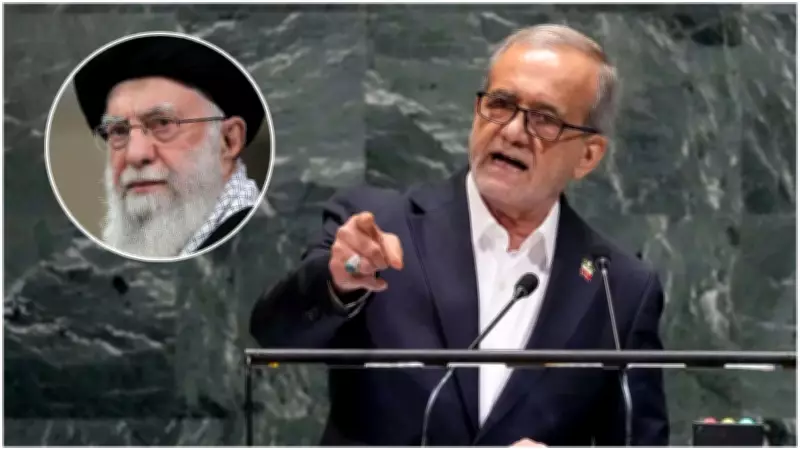
Iran's President Declares Revenge for Khamenei Killing a 'Legitimate Duty'
Iranian President Masoud Pezeshkian has issued a forceful statement declaring that avenging the killing of Supreme Leader Ayatollah Ali Khamenei represents both a "legitimate duty and right" of the Islamic Republic. This declaration follows joint United States and Israeli military strikes that resulted in the death of the 86-year-old spiritual and political leader.
Official Statement and Characterization of the Attack
In a statement broadcast by Iranian state television, President Pezeshkian articulated the government's position clearly. "The Islamic Republic of Iran considers it its legitimate duty and right to avenge the perpetrators and masterminds of this historic crime," he stated. He went further to frame the killing not merely as an assassination but as a broader act of aggression.
Pezeshkian described the death of Khamenei as the assassination of "the highest political authority of the Islamic Republic of Iran and a prominent leader of Shiism worldwide." He asserted that this act is "perceived as an open declaration of war against Muslims, and particularly against Shiites, everywhere in the world." This rhetoric significantly escalates the theological and geopolitical dimensions of the conflict.

Leadership Vacuum and Escalating Tensions
The confirmation of Khamenei's death by Iranian state television and the IRNA news agency early Sunday has plunged the nation into uncertainty. US President Donald Trump had announced the killing hours earlier, framing it as an opportunity for Iranians. He stated it gave them their "greatest chance" to "take back" their country.
The lethal strikes, which Trump described as involving "heavy and pinpoint bombing" targeting Iranian military and governmental sites, mark the second instance in eight months that Washington has attacked Iran during negotiations concerning its nuclear program. The death of Khamenei, who wielded ultimate authority over all major state decisions, creates a profound leadership void. He leaves behind no publicly confirmed successor, raising immediate concerns about internal stability and the potential for regional chaos.
Threats of Retaliation and Regional Fallout
Iran's powerful paramilitary Revolutionary Guard has issued a stark warning, promising to launch its "most intense offensive operation" ever against Israel and US military bases, according to reports from the Associated Press. Echoing this militant stance, Parliament Speaker Mohammad Bagher Qalibaf denounced US and Israeli leaders as "filthy criminals" who would face "devastating blows."
The regional repercussions have been swift and violent:
- In Karachi, Pakistan, at least six people were killed when protesters stormed the US Consulate.
- Tens of thousands demonstrated in Kashmir, chanting anti-US and anti-Israeli slogans while denouncing the killing.
- The Palestinian group Hamas mourned Khamenei's death, labeling the strike a "heinous" US–Israeli attack.
- Islamic Jihad condemned it as a "war crime" executed in a "treacherous and malicious attack."
Compounding the crisis, Iran has endured a near-total internet blackout for a second consecutive day. Data from the internet monitoring group NetBlocks indicates connectivity has plummeted to just 1 percent of normal levels, severely restricting information flow and communication.
A Turning Point in Middle East Conflict
As missile exchanges continue to threaten the region and retaliatory threats escalate, President Pezeshkian's unequivocal statement signals that Tehran views the killing of Ayatollah Khamenei as a transformative event. It is not interpreted simply as an attack on a single leader but as a pivotal moment that could fundamentally reshape the ongoing conflict across the Middle East. The combination of a leadership vacuum, vows of vengeance, and widespread regional unrest creates a highly volatile situation with unpredictable consequences for international security and diplomacy.






