Middle East Awakens to Escalating Military Conflict as US-Israel Strike on Iran Sparks Retaliatory Attacks
The Middle East experienced a dramatic escalation of tensions on Saturday morning, as news spread rapidly about coordinated military strikes conducted by the United States and Israel inside Iranian territory. The situation intensified significantly when US President Donald Trump made a startling announcement claiming that Iran's Supreme Leader Ali Khamenei had been killed during the operation.
This declaration immediately elevated regional tensions to unprecedented levels, prompting cautious responses from governments worldwide and creating nervousness in global markets. Across the Middle East, populations waited anxiously to see how Iran would respond to these developments.
Iranian Retaliation Targets United Arab Emirates
The response came within hours, as reports emerged detailing Iranian retaliatory strikes aimed at multiple locations across the United Arab Emirates. Overnight, residents in Dubai and surrounding areas heard loud explosions as sophisticated air defense systems intercepted incoming drones and ballistic missiles.

For Dubai's cosmopolitan population, the experience felt surreal and unsettling. The city has built its international reputation on safety, luxury living, vibrant nightlife, and predictable routines. When interceptions illuminated the night sky and powerful blasts echoed through residential neighborhoods, initial confusion rapidly transformed into widespread anxiety.
Damage to Iconic Landmarks and Infrastructure
Initial reports indicated that drones targeted areas near Dubai International Airport, one of the world's busiest aviation hubs. Authorities later confirmed that debris from intercepted drones caused significant damage at the iconic Burj Al Arab hotel, where shrapnel sparked a fire that emergency response teams managed to control quickly. Officials emphasized that no injuries were reported from this incident.
Another serious incident occurred at Jebel Ali Port, where debris from interception operations caused a fire at one of the port's berths. Civil Defence teams responded immediately and successfully brought the situation under control, again with no reported injuries.
Personal Accounts Reveal Psychological Impact
As sirens continued through the night and interception operations persisted, residents turned to digital communication channels for real-time information. Family chat groups buzzed constantly with messages as relatives checked on each other's safety across the city.
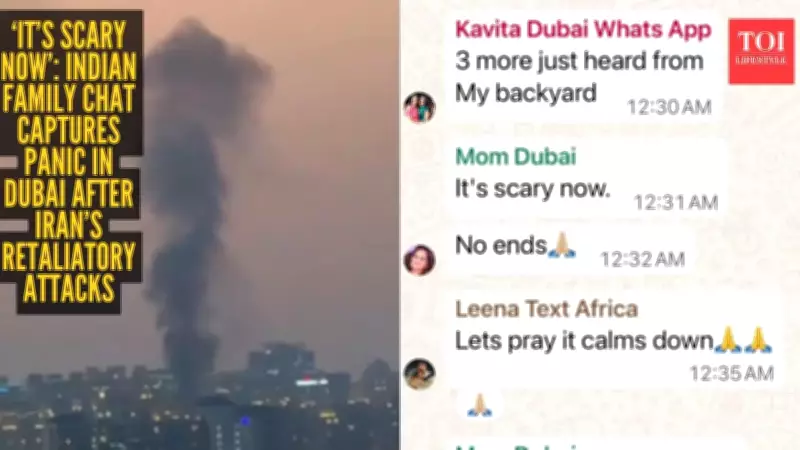
Hong Kong-based entrepreneur Prakash Dadlani shared a revealing screenshot of his family WhatsApp group on social media platform X, showing relatives in Dubai describing events as they unfolded. One message from a contact saved as "Kavita Dubai WhatsApp" read: "3 more just heard from my backyard." Moments later came another message stating: "It's scary now. No ends."
Dadlani expressed his disbelief at seeing such conversations connected to Dubai, writing: "Dubai is one of the safest cities in the world. Never imagined my family chat would look like this one day."
UAE Defense Systems Demonstrate Capability
While social media platforms filled with worry and speculation, UAE authorities moved swiftly to reassure residents about their safety. The UAE Ministry of Defence announced that its air force and air defense systems had intercepted and destroyed a substantial number of incoming threats since the attacks began.
Official statements revealed that defense systems successfully neutralized 137 ballistic missiles and 209 drones aimed toward Emirati territory. Military officials described this response as clear evidence of strong preparedness and effective defense capabilities.
Authorities emphasized throughout the night that emergency services remained fully operational and that the situation was being monitored closely at the highest levels of government.
Psychological Shift for Dubai Residents
Despite official reassurances, a significant psychological shift occurred for many Dubai residents. For decades, Dubai has symbolized stability and security in a region often characterized by geopolitical tensions. Residents have grown accustomed to watching conflicts unfold on television screens rather than hearing their echoes outside their windows.

This is why the psychological impact felt particularly profound. The conflict suddenly stopped feeling distant and abstract, moving from international headlines into living rooms, balconies, and late-night family conversations filled with uncertainty.
Global Response and Regional Implications
What began as a military confrontation between powerful nations quickly transformed into an emotional reality for civilians across the Gulf region. People found themselves checking the sky, refreshing news applications constantly, and wondering what the coming hours might bring.
Global leaders are now urging restraint from all parties involved, hoping the escalation doesn't spiral further into broader regional conflict. Diplomatic channels are expected to work quietly behind the scenes to de-escalate tensions. Yet for ordinary residents across the Middle East, uncertainty remains the dominant emotion.
Such moments fundamentally change how a region perceives itself overnight. While the explosions may have been intercepted and the fires controlled, and while daily life may resume its normal patterns soon, for those who heard those sounds in the darkness, the night served as a powerful reminder that even places known for calm and stability can suddenly find themselves at the center of global tensions.
Across the Middle East, populations are now watching developments carefully, hoping this represents a warning shot rather than the beginning of something much larger and more dangerous for regional stability.