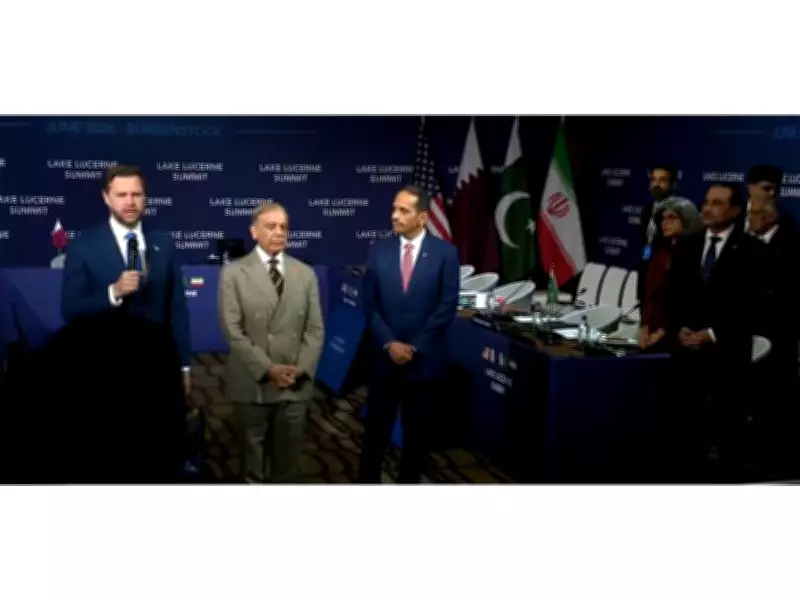
US Vice President JD Vance declared on Sunday that the United States is prepared to "fundamentally transform" its long-strained relationship with Iran, provided the Islamic Republic abandons its nuclear weapons ambitions and ceases to be a driver of regional instability. Speaking ahead of a high-stakes meeting with Iranian officials at the Burgenstock resort in Switzerland, Vance emphasized the unprecedented nature of the talks, noting that never before have Iranian and American leadership met at such a high level.
Conditional Roadmap for Reconciliation
Vance outlined a conditional yet sweeping roadmap authorized by the White House, charting a path toward comprehensive reconciliation if Tehran addresses core international security concerns. "What the President (Donald Trump) has asked us to do is turn over a new leaf to transform our relationship with the people of Iran, and to extend an outstretched hand that says to the people of Iran that if your leadership is willing to give up being a driver of regional instability, if they are willing to give up nuclear weapons ambitions for the long term, then the United States is willing to fundamentally transform our relationship with that country," he explained. He added that this is certainly the goal of the US delegation.
Progress in Early Talks
Reflecting strong optimism regarding the early momentum established by the diplomatic delegations behind closed doors, Vance noted, "We've already made great progress over just the last few hours, and I expect that we will make additional progress in the hours to come." The talks are being steered through the joint mediation of Qatar and Pakistan, as confirmed by Qatar's Foreign Ministry, which announced the formal commencement of negotiations. The ministry expressed its aspiration that these meetings will lead to a comprehensive and permanent agreement addressing all aspects covered in the Memorandum of Understanding (MoU).

Technical and Monitoring Groups Formed
The ministry statement provided details on the operational structure of the dialogue, noting that specialized technical and expert groups have been formed to negotiate the terms of the final agreement. Additional monitoring bodies have been put in place to maintain strict oversight during the framework. "Additionally, follow-up groups have been established to oversee the implementation of the Memorandum, monitor progress achieved, and work toward the conclusion of the final agreement," the statement added.
Background of the MoU and Delegations
This critical diplomatic push gained significant momentum following the arrival of heavyweight delegations at the Burgenstock resort on Sunday. These technical-level negotiations are operating under a 14-point Memorandum of Understanding finalized on June 17 by US President Donald Trump and Iranian President Masoud Pezeshkian, initiating a strict 60-day window to iron out key operational disputes and restore long-term stability across West Asia. Vance landed in Switzerland earlier on Sunday to join American negotiators Steve Witkoff and Jared Kushner, who were already on-site handling the framework's technical dimensions. The Iranian delegation, according to Iranian state television, is heavily weighted towards economic and financial leverage, comprising parliamentary speaker Mohammad Bagher Ghalibaf and Foreign Minister Abbas Araghchi, alongside key officials from Iran's central bank and oil ministry.
Delays and Strategic Importance
While these crucial proceedings were originally scheduled to commence on Friday, they faced sudden, unexpected delays due to recent exchanges of fire between Israel and Lebanon, which threatened to derail the strict diplomatic timeline. Beyond immediate territorial concerns, a primary objective behind these urgent negotiations is securing critical global energy corridors. The initial finalization of the MoU had prompted the reopening of the strategic Strait of Hormuz maritime route, which handles nearly 20 percent of global energy supplies under normal conditions. The vital waterway had been blocked since February 28 following joint military strikes by the US and Israel on Iran, which provoked retaliatory actions from Tehran.

Fluid Maritime Situation
However, as the afternoon negotiations are underway, the maritime situation remains highly fluid and contradictory. Tehran claimed on Saturday that it had shut down the waterway once again following an Israeli strike in Lebanon, whereas the United States firmly maintained that the maritime route remains open, adding a critical layer of economic stakes to the ongoing dialogue.