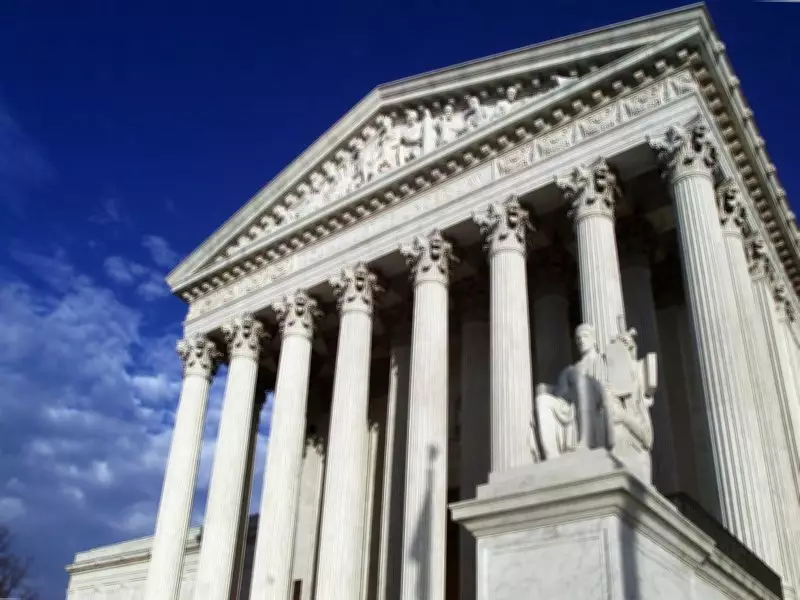
Supreme Court Backs Trump Administration on Asylum Restrictions
The Trump administration celebrated a series of US Supreme Court immigration rulings on June 25, 2026, including a decision that permits officials to turn away migrants seeking asylum at the US-Mexico border before they physically enter the country. Administration officials described the rulings as a major victory for immigration enforcement and for reinforcing the temporary nature of humanitarian protections.
In a post on X, Secretary of the US Department of Homeland Security Markwayne Mullin stated, 'The three rulings from the Supreme Court this week are all victories for enforcing our nation's immigration laws.' He elaborated that the rulings bar aliens from applying for asylum if they have not set foot in the United States, make it easier to remove lawful permanent residents who commit crimes, and reaffirm that Temporary Protected Status (TPS) was always intended to be temporary and can be cancelled at the appropriate time. Mullin added that these decisions provide 'tools we need to continue securing our nation.'
TPS Termination for Haitian and Syrian Nationals Upheld
US Acting Attorney General Todd Blanche highlighted on X that the Supreme Court upheld the Trump administration's authority to terminate Temporary Protected Status for hundreds of thousands of Haitian and Syrian nationals. Blanche said, 'Today the Supreme Court upheld the Trump Administration's clear authority to terminate Temporary Protected Status for hundreds of thousands of Haitian and Syrian nationals.' He added that the Department of Justice successfully defended the position that TPS was always meant to be temporary, and that the ruling 'rejects efforts to turn the program into a loophole abused by illegal aliens to remain in the United States.' Blanche expressed pride in the department's work to advance President Trump's agenda of securing borders and upholding the rule of law.

Metering Policy Upheld by 6-3 Vote
According to the New York Post, the Supreme Court ruled 6-3 that the Trump administration can enforce a policy known as 'metering,' which allows border officials to limit the number of migrants permitted to seek asylum at ports of entry each day. The majority opinion, written by Justice Samuel Alito, stated, 'In ordinary speech, no one would say that a person "arrives in" a place—for example, a house, a city, or a country—before the person enters that place.' The opinion emphasized that the phrase 'arrives in the United States' in immigration statutes supports an ordinary-meaning reading. The Trump administration argued that metering was necessary to manage large numbers of migrants at the southern border, noting that those initially turned away could return later to seek asylum.
White House and Dissenting Views
White House spokeswoman Abigail Jackson called the ruling 'a tremendous win for the Trump Administration, the rule of law, and common sense.' She said President Trump remains committed to 'lawfully restoring integrity to our immigration system, which includes tackling the egregious abuses to our asylum system that the prior administration encouraged.' All three Democratic-appointed justices dissented. Justice Sonia Sotomayor read part of her dissent from the bench, stating that the ruling 'regrettably and tragically extinguishes the light of the torch of the Statue of Liberty.'
Background of the Metering Policy
The metering policy was first introduced during the Obama administration in 2016, expanded nationwide under Trump's first term, suspended during the COVID-19 pandemic in 2020, and formally rescinded by the Biden administration in 2021. A California federal judge later ruled the policy unlawful in 2021, a decision affirmed by the Ninth Circuit before the Supreme Court reversed it. The rulings collectively strengthen the administration's ability to enforce immigration laws and limit asylum claims at the southern border.