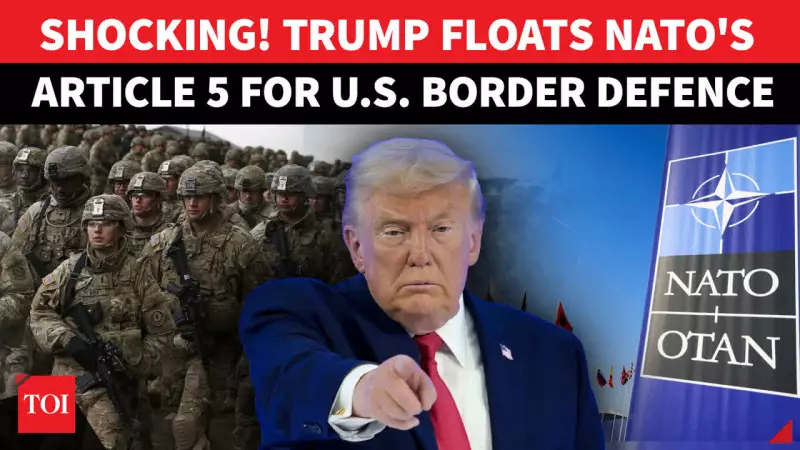
Trump Proposes Unprecedented NATO Role in US Border Crisis
US President Donald Trump has ignited a major transatlantic controversy by suggesting that NATO's foundational Article 5 collective defense clause could have been invoked to address what he termed an "invasion" at the American southern border. This unprecedented interpretation of the alliance's core mutual defense provision represents a sharp departure from historical understanding and has sent shockwaves through NATO capitals.
A Radical Reinterpretation of Collective Defense
The President's remarks come amid escalating tensions with European allies over multiple issues, including disputes concerning Greenland and broader questions about burden-sharing within the North Atlantic Treaty Organization. Trump argued that the scale of illegal immigration at the US-Mexico border should have triggered allied support under Article 5, which states that an armed attack against one member shall be considered an attack against all.
This suggestion fundamentally challenges how Article 5 has been understood since NATO's inception in 1949. Historically, the clause has been reserved for military attacks against member territories, most famously invoked following the September 11, 2001 terrorist attacks against the United States. Applying it to border security and immigration matters would represent a dramatic expansion of the alliance's scope and purpose.

Reactions and Broader Implications
The President's comments have unsettled diplomatic circles across NATO member states, reopening fundamental debates about:
- The alliance's evolving purpose in the 21st century
- The limits of collective defense obligations
- America's changing expectations of its European partners
- The potential politicization of security frameworks
European officials are reportedly concerned that this proposal could further strain already tense transatlantic relations. The suggestion comes at a particularly sensitive moment, as NATO members navigate complex geopolitical challenges including:
- Ongoing tensions with Russia
- Questions about European defense autonomy
- Diverging priorities between North American and European members
The border security proposal represents the latest in a series of unconventional approaches to international alliances by the Trump administration. It raises profound questions about how traditional security frameworks might be reinterpreted to address non-traditional threats, and whether such reinterpretations could fundamentally alter the nature of international defense partnerships.
As NATO capitals digest this unexpected suggestion, analysts are watching closely to see whether this represents rhetorical positioning or signals a genuine attempt to redefine collective defense parameters. The outcome of this debate could have lasting implications for transatlantic security cooperation and the future of multilateral defense arrangements worldwide.