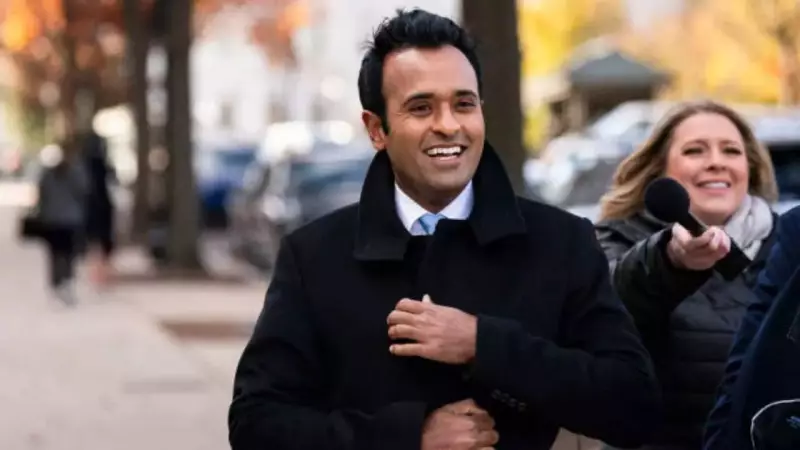
In the heated political climate of former President Donald Trump's second-term focus, immigration has taken center stage, often overshadowed only by debates on tariffs. This environment has emboldened conservative voices, bringing controversial and offensive terminology back into the mainstream discourse. One such term, 'anchor baby,' has recently been weaponized in a racist attack against Indian-American entrepreneur and former Republican presidential candidate, Vivek Ramaswamy.
The Racist Attack and Ramaswamy's Stance on Americanness
The controversy ignited after Vivek Ramaswamy penned an op-ed for The New York Times, articulating his vision of American identity. He argued that being American is a binary choice, defined by belief in the rule of law, the Constitution, and swearing exclusive allegiance to the nation, not by ancestry. "Americanness isn’t a scalar quality that varies based on your ancestry. It’s binary: Either you’re an American or you’re not," he wrote.
In response, popular far-right activist Nick Fuentes launched a vitriolic attack on X (formerly Twitter). Dismissing Ramaswamy's arguments, Fuentes wrote, "Reminder that Vivek Ramaswamy is an actual anchor baby, so everything he says can be completely disregarded. Foreigners who have no right to be here don’t get to lecture me about what it is to be American." This statement aimed to delegitimize Ramaswamy's voice using a loaded, derogatory term.

What Exactly is an 'Anchor Baby'?
The term 'anchor baby' is defined as a child born to a mother who is not a legal citizen in a country that grants automatic citizenship by birth, like the United States. It carries the derogatory implication that the birth was strategically planned to secure the parents' future legal residency or citizenship. Recognized as offensive, the term was formally added to the New American Heritage Dictionary in 2011, cementing its place in the lexicon of American political rhetoric.
Its modern usage surged around 2006 during intense Congressional debates on immigration reform, which included proposals for a 700-mile border fence and a path to legal status for some. Although those bills did not become law, the term became a rallying cry in protests, used to question the legitimacy of birthright citizenship under the 14th Amendment.
Is Vivek Ramaswamy Factually an 'Anchor Baby'?
Examining the facts of Ramaswamy's birth and family history reveals the inaccuracy of Fuentes's slur. Vivek Ramaswamy was born in Cincinnati, Ohio, making him a natural-born U.S. citizen. His parents, V. Ganapathy Ramaswamy and Geetha Ramaswamy, immigrated legally to the U.S. from Kerala, India.
His father, an engineer and patent attorney, chose not to become a U.S. citizen for familial reasons. However, his mother, a geriatric psychiatrist, took the citizenship test and was naturalized. Since at least one parent was a legal immigrant and his mother later became a citizen, and given that the term specifically targets children of *undocumented* parents, Vivek Ramaswamy is factually not an 'anchor baby.' The label is a political slur, used here as verbal ammunition in the wider conservative immigration debate.
Why This Loaded Term Persists in Political Discourse
Immigration remains one of America's most polarized issues. Terms like 'anchor baby' persist because they tap into fundamental, emotionally charged questions: Who is a true American? Who belongs? It simplifies a complex debate into a potent soundbite that questions the validity of birthright citizenship—a cornerstone of American law established by foreigners.
In today's context, marked by ICE raids, H-1B visa uncertainties, and stringent policies, the term is used by a section of society to categorize and offend, feeding an ideological narrative that excludes and others. The attack on Ramaswamy underscores how this rhetoric is now being directed even at conservative, legal immigrants who challenge nativist viewpoints within their own political camp.
The incident highlights the deep fractures within American politics, where immigration is not just a policy issue but a battleground for identity and belonging, with derogatory language often replacing substantive debate.