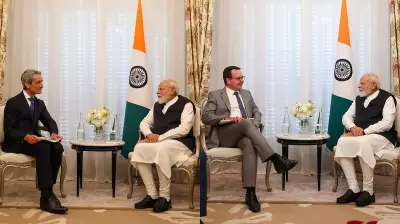
India and the United States are set to hold ministerial-level negotiations this week to advance the first phase of their proposed bilateral trade agreement (BTA). US Trade Representative Jamieson Greer will arrive in New Delhi for two days of talks with Commerce and Industry Minister Piyush Goyal.
"For the US trade deal talks, tomorrow my counterpart is coming to Delhi," Goyal told reporters in Mumbai, as quoted by PTI.
High-level engagement follows chief negotiator talks
The high-level engagement comes after chief negotiator-level discussions held in New Delhi from June 2 to June 4. The talks are expected to focus on finalising the framework of the interim trade pact. Commerce Secretary Rajesh Agrawal has recently stated that discussions between the two ministers are likely to centre around giving final touches to the framework deal.

On June 5, Goyal had said India and the US were moving towards closing all open issues in the interim agreement and were likely to execute the "very, very vibrant" first phase of the BTA by the middle of next month.
Why the next few weeks matter
The talks assume significance as the US' 10% temporary tariff imposed on all trading partners on February 24 for 150 days is set to expire on July 24. Once the temporary levy expires, the US will need to put in place a new tariff regime. The additional tariff is levied over and above Most Favoured Nation (MFN) duties.
To determine its future tariff framework, Washington is currently conducting two Section 301 investigations involving several countries, including India.
Section 301 probes under way
In March, the US Trade Representative launched two Section 301 investigations under the Trade Act of 1974 covering multiple countries, including India, over excess industrial capacity and alleged failures to eliminate forced labour from global supply chains. On June 2, the USTR proposed imposing 12.5% tariffs on imports from 54 countries, including India, for allegedly failing to prohibit goods produced through forced labour. The proposal has not yet been finalised. Interested parties can submit hearing requests and testimony summaries until June 22, while hearings are scheduled for July 7. The findings of the second probe are still awaited.
Trade framework being recalibrated
The current negotiations are also taking place against the backdrop of changes in US tariff policy. On February 20, the US Supreme Court ruled against President Donald Trump's reciprocal tariffs imposed under the International Emergency Economic Powers Act (IEEPA), under which India had been facing a 50% tariff. Following the ruling, the US replaced those measures with the temporary 10% tariff regime that remains in place until July 24.
India and the US had earlier agreed on the framework of the first phase of the BTA in a joint statement issued on February 7. Under that framework, the US had agreed to reduce tariffs on Indian goods to 18% from 50%. It had also removed the 25% tariffs imposed on Indian goods linked to purchases of Russian oil and was expected to reduce the remaining 25% tariff to 18% under the agreement. However, the Supreme Court ruling altered the tariff landscape, prompting both sides to revisit elements of the framework. The February joint statement contains a provision allowing either country to modify commitments if the agreed tariff structure changes.
India seeks tariff edge over competitors
Sources have indicated to news agency PTI that securing a tariff advantage over competing exporting nations remains a key objective for India. When the framework was initially agreed, Indian goods were to face an 18% tariff while competing countries such as Vietnam and other ASEAN economies were expected to face tariffs ranging between 19% and 20%. However, under the temporary US regime, all countries currently face the same additional 10% levy. According to sources, India wants the final trade pact to restore a differential tariff structure that gives Indian exporters an advantage over competitors such as Vietnam, Bangladesh, Pakistan and ASEAN nations. Such an advantage would make Indian products relatively cheaper in the US market and potentially help exporters gain market share.

Trade ties remain strong
The US was India's second-largest trading partner in 2025-26. India's exports to the US rose 0.92% to USD 87.3 billion during the fiscal year, while imports increased 15.95% to USD 52.9 billion. India's trade surplus with the US narrowed to USD 34.4 billion in 2025-26 from USD 40.89 billion in the previous year.