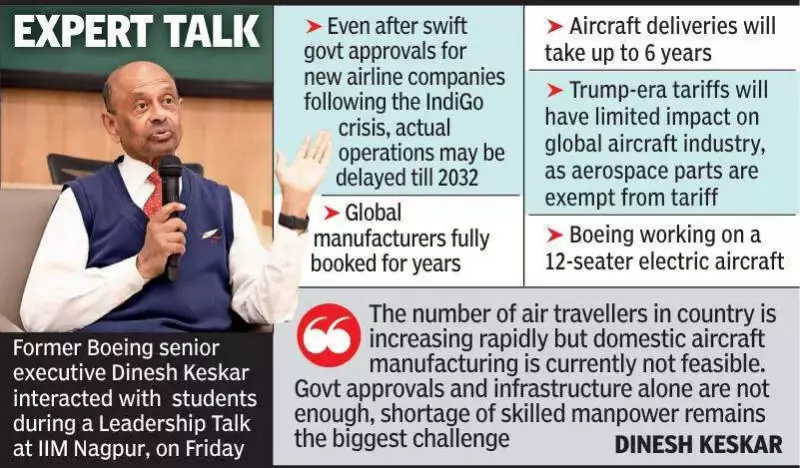
India's plans to welcome new airline companies, fast-tracked after recent aviation turbulence, face a harsh reality check. A severe global aircraft shortage could push their actual launch dates to as late as 2032, a top industry expert has revealed.
Global Backlog Stalls Indian Aviation Ambitions
Speaking at a Leadership Talk at the Indian Institute of Management (IIM) Nagpur on Friday, former Boeing senior vice-president Dinesh Keskar delivered a sobering assessment. He stated that while the government might swiftly approve new airline licenses, actual operations could be delayed until 2032 due to a crippling shortage of aircraft.
Keskar explained that global aircraft manufacturers like Boeing and Airbus are fully booked for several years. "Even if an order is placed with Boeing today, delivery will take around six years," he told students. This massive backlog means new entrants cannot secure planes quickly, making an immediate start to operations virtually impossible.

Beyond Planes: The Skilled Manpower Crisis
The challenges for India's booming aviation sector extend far beyond just hardware. Keskar, who held key leadership roles at Boeing for over two decades, identified a critical bottleneck: a severe shortage of skilled manpower. He asserted that government approvals and infrastructure alone are insufficient.
"Land, electricity, and water may be available, but highly skilled engineers and technicians are not easily found," Keskar explained. He highlighted this as a primary reason why Boeing maintains only two major aircraft manufacturing facilities globally, both in the United States. This talent gap, he warned, remains the biggest hurdle for domestic aircraft manufacturing in India, despite the rapid rise in air travellers.
Monopoly Risks and Future Technologies
Alluding to the recent crisis in civil aviation, Keskar pointed to the risks of market concentration. "One private player controls a major part of India's airline market, and monopoly always creates problems," he cautioned, without naming any specific airline.
On a futuristic note, he shared that Boeing is developing a 12-seater electric aircraft, calling it a "fascinating idea" with game-changing potential, though it will take time to mature. He also addressed trade concerns, noting that the much-discussed Trump-era tariffs would have a limited impact on the aerospace industry as parts are often exempt, and the issue is likely to be resolved soon.
Reflecting on his roots, Keskar spoke fondly of his childhood in Amravati and his engineering education at VNIT Nagpur, underscoring his deep connection to the Vidarbha region. The session was inaugurated by IIM Nagpur director Bhimaraya Metri, with Prof Alok Kumar Singh, Dean of Executive Education, facilitating the former aviation veteran.