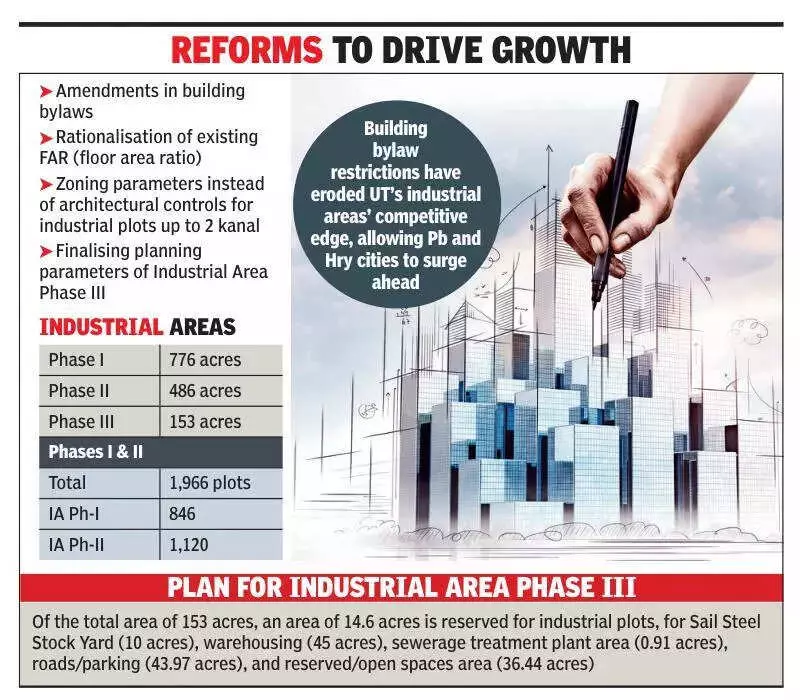
In a decisive push to rejuvenate its economic engine, the Chandigarh administration is embarking on a comprehensive revision of its building bylaws, with a sharp focus on liberating the industrial sector from restrictive decades-old rules. A high-powered committee, formed under the direct mandate of the UT Administrator and led by the Deputy Commissioner-cum-Estate Officer, is spearheading this transformative initiative aimed at reversing the city's industrial decline.
Core Reforms: Unshackling Industry with New FAR and Zoning
The reform agenda is centered on several key changes designed to make industrial operations in Chandigarh viable and competitive once more. A primary focus is increasing the permissible Floor Area Ratio (FAR) for industrial plots, which has long been a major pain point for businesses. Currently, Chandigarh enforces an FAR of just 0.75, a figure industry representatives have consistently labelled as economically crippling.
This restrictive FAR stands in stark contrast to the neighbouring industrial hubs in Punjab, Haryana, and Himachal Pradesh—such as Mohali, Panchkula, Dera Bassi, Barwala, and Baddi—where FAR ranges from a much more generous 2.5 to 3. The committee is actively working to rationalise the existing FAR for Industrial Area Phase I and II. It is noteworthy that a minor increase from 0.75 to 1.0, along with a 10% boost in ground coverage for cycle sheds, was permitted back in 2000 for plots up to 1 acre, but prohibitive charges deterred most industrialists from availing it.

Another significant shift involves replacing architectural controls with zoning parameters for industrial plots up to 2 kanal in size. This move is expected to provide greater flexibility and reduce procedural hurdles for a substantial portion of industrial plots. Smaller plots of 5 marla to 1 kanal make up 33% of Phase I and a massive 95% of Phase II, meaning this change will impact the majority of plot holders.
Driving Force: Regaining Lost Competitive Edge
The urgent need for these amendments stems from Chandigarh's prolonged loss of competitive ground to its neighbours. A senior UT official explicitly stated that the industrial area is in "dire need of deregulation" and identified the building bye-laws as a major inhibiting factor. The committee's official mandate is to "amend building regulations to reduce land loss in industrial plots," signalling a move towards more efficient land use.
The 11-member committee, which includes the UT Chief Architect and UT Chief Engineer, represents all key departments. Their work addresses the long-standing demand from industry bodies for regulatory relaxation to halt the exodus of business and investment to more industry-friendly states.
Finalising the Future: Development of Industrial Area Phase III
Beyond reforming rules for existing areas, the committee is also tasked with finalising the planning parameters for the long-pending Industrial Area Phase III. Located near villages Raipur Kalan and Mauli Jagran, Phase III spans 153 acres. While land for this phase was acquired in 2003, following a proposal initiated as far back as 1977, it has remained undeveloped.
The UT administration now plans to start auctioning plots in Phase III from the coming financial year. The committee will determine the development blueprint for this area, which includes plots ranging from marla sizes to 4 kanal. Of the total 153 acres, 14.6 acres are earmarked for industrial plots, with other portions reserved for a SAIL Steel Stock Yard (10 acres), warehousing (45 acres), a sewage treatment plant, roads, parking, and open spaces.
This two-pronged strategy—revitalising the fully developed Phases I and II (with over 1,800 plots across 1,262 acres) while kickstarting Phase III—aims to comprehensively reposition Chandigarh as a attractive and modern destination for industrial investment in the region.