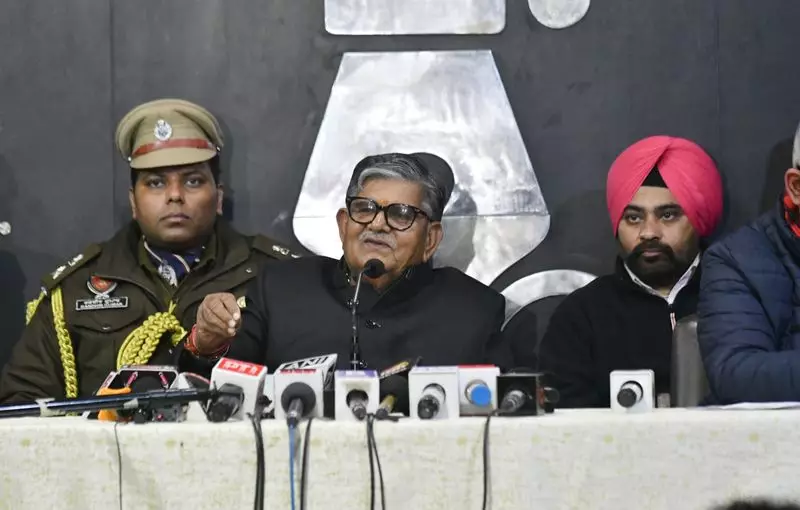
The long-awaited Chandigarh Metro Rail project faces a critical precondition for its viability: it must extend beyond the city's borders to include the neighbouring satellite cities of Panchkula and Mohali. This essential requirement was strongly emphasized by Member of Parliament Kirron Kher during a recent review meeting focused on the project's progress.
Connectivity to Tricity is Non-Negotiable
According to the detailed discussions, the project's financial and operational success is intrinsically tied to serving the larger Tricity region. Kirron Kher, the BJP MP from Chandigarh, made it clear that a metro confined solely to Chandigarh would not be a feasible venture. The population and commuter base of Chandigarh alone are insufficient to justify the massive investment required for a modern metro rail system.
The logic is rooted in urban dynamics. Panchkula, located in Haryana, and Mohali (SAS Nagar), situated in Punjab, are integral parts of the daily economic and social fabric of the region. Thousands of residents commute between these cities and Chandigarh for work, education, and healthcare. A metro line that seamlessly connects all three points would not only ease chronic traffic congestion but also ensure high ridership from day one, making the project economically sustainable.

Financial Hurdles and the Search for Funding
The meeting, chaired by Kirron Kher, also delved into the significant financial challenges blocking the project's path forward. A major point of contention is the funding model. The estimated cost for the comprehensive Tricity metro network is a staggering Rs. 10,570 crore. The central government's current Metro policy mandates that state governments bear a substantial portion of the project cost, which has become a sticking point.
Herein lies the complexity: the metro project spans three separate administrative entities—the Union Territory of Chandigarh, and the states of Punjab and Haryana. Achieving a consensus on cost-sharing among these governments has proven difficult. Officials from the Chandigarh Administration presented the current status and the hurdles faced due to this financial impasse.
Advocacy for Central Government Support
In response to these challenges, MP Kirron Kher has taken a proactive stance. She has decided to spearhead efforts to lobby the central government for a special funding package. Her argument is that Chandigarh, as the nation's first planned city and a symbol of modern India, deserves an exception to the standard funding rules.
Kher plans to engage directly with top Union Ministers, including Finance Minister Nirmala Sitharaman and Housing and Urban Affairs Minister Hardeep Singh Puri. The goal is to secure a financial arrangement where the central government covers a larger share of the capital expenditure, reducing the burden on the partner states and the UT. This, she believes, is the key to unlocking the project and commencing actual construction work.
The push for the Chandigarh Metro has been ongoing for years, with detailed project reports (DPRs) prepared and reviewed. However, without a clear and agreed-upon financial roadmap, the project remains on paper. The recent meeting underscores a renewed political push to translate plans into reality, with connectivity as the central pillar and central assistance as the needed catalyst.