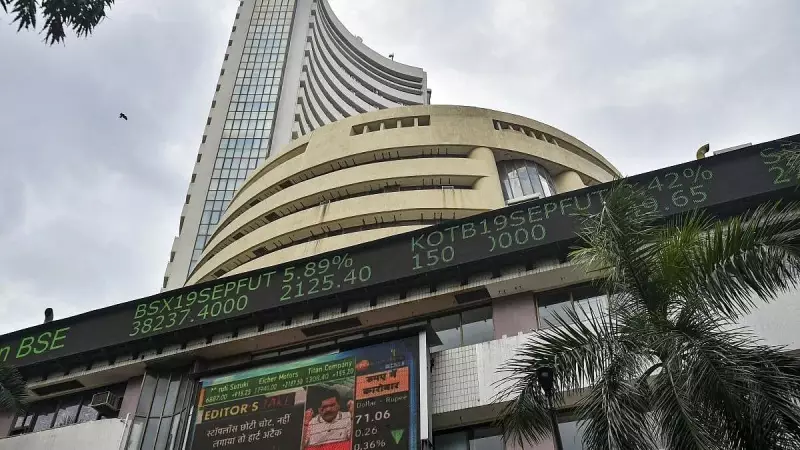
Indian equity benchmarks extended their losing streak for the fifth consecutive trading session on Thursday, closing sharply lower amid weak global cues and sustained selling pressure across sectors.
Markets Extend Losses Amid Global Pressure
The benchmark S&P BSE Sensex plunged by 453.85 points, or 0.59%, to settle at 76,490.08. During the trading day, the index had dropped as much as 621 points, hitting an intraday low of 76,323. Similarly, the broader NSE Nifty 50 index fell by 123.30 points, or 0.53%, to end the session at 23,259.20. This marked the fifth straight day of declines for both indices, reflecting persistent bearish sentiment.
The market breadth was overwhelmingly negative, indicating broad-based selling. On the BSE, a staggering 2,766 stocks declined, while only 1,006 managed to advance. The total market capitalization of BSE-listed firms eroded significantly, dropping by approximately ₹2.5 lakh crore to around ₹424.7 lakh crore.

Sectoral Performance and Major Losers
The sell-off was widespread, with most major sectoral indices ending in the red. The Nifty Metal index was the worst performer, tumbling by 2.3%. The Nifty Realty and Nifty PSU Bank indices also faced heavy selling pressure, declining by 1.9% and 1.8%, respectively.
Among the heavyweight constituents of the Sensex, major losses were seen. Mahindra & Mahindra (M&M) was the top loser, shedding 2.5%. It was followed by State Bank of India (SBI), which fell by 2.2%. Other prominent laggards included Tata Steel, NTPC, and Power Grid Corporation, each dropping between 1.5% and 2%.
Interestingly, the downturn occurred despite some buying interest in a few index heavyweights. Hindustan Unilever (HUL) gained 1.7%, while Bharti Airtel and Asian Paints also closed in positive territory, providing some cushion to the falling indices.
Expert Analysis and Market Outlook
Market analysts attributed the prolonged correction to a combination of domestic and international factors. Profit booking after the recent record-breaking rally was cited as a primary reason. Additionally, investors turned cautious ahead of the Union Budget and the upcoming quarterly earnings season, preferring to lock in gains.
Global markets also presented a weak backdrop. Asian peers like Hang Seng and KOSPI traded lower, while European markets opened on a negative note. This dampened risk appetite among foreign portfolio investors (FPIs). The fear of a potential delay in interest rate cuts by the US Federal Reserve further contributed to the negative sentiment, impacting emerging markets like India.
Experts suggest that the market may continue to see volatility in the near term. Support levels for the Nifty are now seen around 23,200-23,150. A decisive break below this zone could trigger further selling. Conversely, any recovery would need to see the index sustain above the 23,400 level. Traders are advised to adopt a stock-specific approach and avoid aggressive bets until the market shows clear signs of stability.