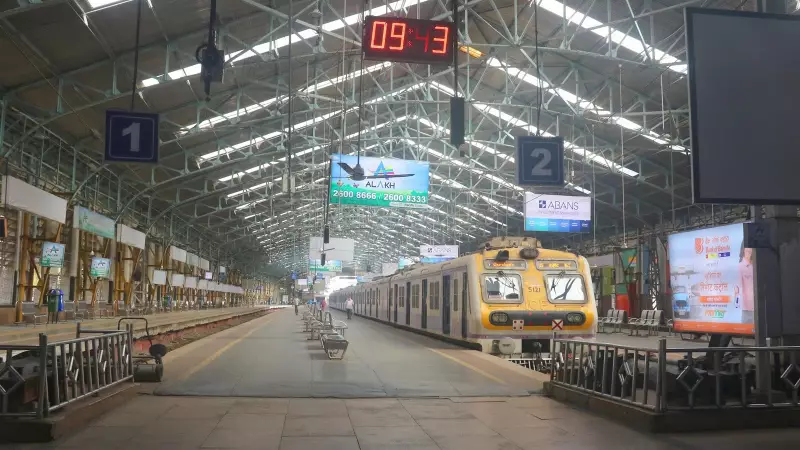
In a significant boost to commuter safety, the installation of the indigenous KAVACH Automatic Train Protection (ATP) system on Mumbai's bustling Virar-Churchgate suburban corridor has crossed the halfway mark. Western Railway officials have confirmed that the Rs 67-crore project has achieved 50% physical progress and is slated for completion by September 2024.
What is KAVACH and Why is it Crucial for Mumbai?
The Virar-Churchgate stretch, spanning 60 kilometres, is one of the most intensively used suburban railway sections in India, ferrying lakhs of passengers daily. The implementation of KAVACH, developed under the 'Atmanirbhar Bharat' initiative, represents a critical safety intervention. Unlike a traditional signalling system, KAVACH acts as a protective layer that works alongside existing infrastructure.
"KAVACH is not a signalling system. It is an automatic train protection layer designed to work alongside existing signalling infrastructure," clarified Vineeth Abhishek, Chief Public Relations Officer of Western Railway. Its primary function is to prevent train collisions and Signal Passing at Danger (SPAD) incidents by continuously monitoring train speed and signal status, automatically applying brakes if a violation is detected.

Detailed Progress Report of the Installation
Railway authorities have provided a granular breakdown of the work completed so far. The groundwork and surveys for Radio Signal Strength Indicator (RSSI) towers are fully complete, with all 17 tower locations identified. Foundation work has crossed 80%, and the erection of towers has reached nearly 50%.
At the station level, KAVACH and Traffic Collision Avoidance System (TCAS) equipment is already operational at six locations, marking 35.3% progress. Key components for precise train tracking, such as LIDAR-based mapping and RFID tagging, are each about 40% complete. Furthermore, the laying of optical fibre cables, which form the communication backbone for KAVACH, has progressed beyond 60%. Locomotive trials have also been successfully conducted on a 24-km section of the corridor.
Enhanced Safety and Operational Benefits
The integration of KAVACH is expected to bring a paradigm shift in safety and operational efficiency. By enforcing safe braking curves and reducing reliance on manual responses during emergencies, the system aims to minimise disruptions and stabilise operations.
"It acts as an additional safety layer that continuously monitors train movement and intervenes only when safety limits are breached," explained Abhishek. This enhancement allows for better utilisation of existing track capacity, potentially supporting denser train operations during peak hours without compromising on passenger safety. The system is designed to be a fail-safe mechanism that significantly reduces risks stemming from human error.
The timely completion of this project on the Virar-Churchgate corridor will serve as a major benchmark for the nationwide rollout of KAVACH, promising a safer future for millions of Indian railway commuters.