Nature holds some of the most mystical secrets, and one such strange phenomenon is the shedding of snake skin. Often considered disgusting, this process has a deeper meaning and is literally a survival mechanism for snakes. Here is everything you need to know about this bizarre natural process.
What Really Happens?
Imagine your clothes fusing into your body as you grow, becoming so tight that you can barely move. While this would suffocate a human, for a snake, getting rid of such confinement is a mere survival skill. Essentially, this is what life is like for a snake just before it sheds its old skin and acquires a new one. Unlike other reptiles, a snake's skin does not stretch or grow along with its body. To continue growing, they must cast off their old skin in one complete, dramatic piece. This biological process is known as ecdysis, and it is one of the most vital routines in a snake's life.
Why Do Snakes Shed Their Skin?
One of the primary reasons a snake sheds is when it outgrows its skin. While a snake's internal organs, muscles, and bones keep expanding as it eats, its outer layer of scales remains a fixed size. This is especially true for younger snakes that feed constantly and grow rapidly; they might shed their skin every few weeks. However, older, mature snakes have much slower growth rates and may only need to shed three to four times a year. If a snake does not shed its old skin, it becomes tight, restrictive, and can even cut off circulation to vital parts of its body.

Clearing Out Parasites
Slithering along dirt, rocks, and mud means snakes are constantly exposed to external pests. Ticks, mites, and harmful bacteria love to lodge themselves underneath a snake's scales, where they can cause infections or drain the reptile's energy. Shedding acts as a natural, full-body detox. By peeling away the entire outer layer of skin, the snake effectively evicts all those unwanted parasites in one go, leaving them trapped on the discarded, empty sheath of skin.
Turning Blue
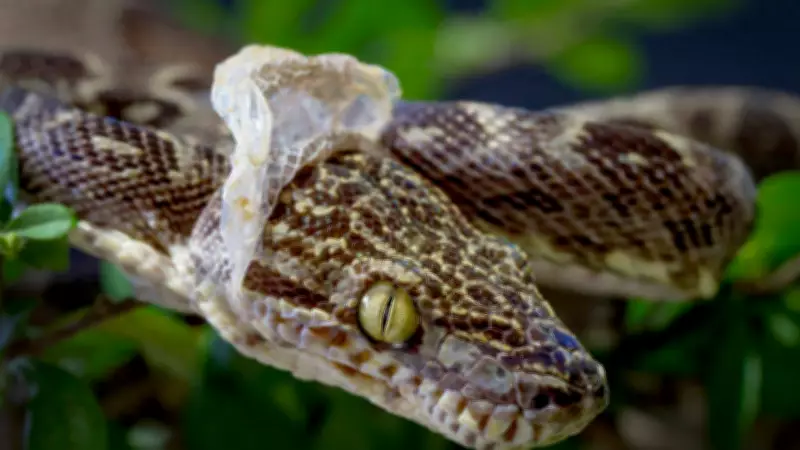
You can usually tell when a snake is preparing to shed by looking closely at its eyes. A few days before the big event, the snake's eyes turn a cloudy, milky blue color. Snakes do not have eyelids; instead, they have a single transparent scale called a spectacle or eye cap protecting each eye. When a snake prepares to shed, its body secretes a fluid between the old layer of skin and the shiny new layer forming beneath it. This fluid lubricates the separation process, but it also temporarily blinds the snake, making them incredibly nervous, defensive, and reclusive during this phase.
How the Peel Actually Happens
Once the fluid is reabsorbed and the snake's eyes clear up, it is time for the main event. The snake will find a rough surface—such as a jagged rock, a coarse tree branch, or even a tight crevice—and begin rubbing its snout against it. By friction alone, the snake rips the skin open right at the mouth. Once the skin is anchored to a rough object, the snake literally crawls out of its own face, turning the old skin completely inside out as it slithers forward. A healthy, well-hydrated snake will leave behind a perfect, unbroken tube of scales, emerging into the world with vibrant, glossy new colors.