

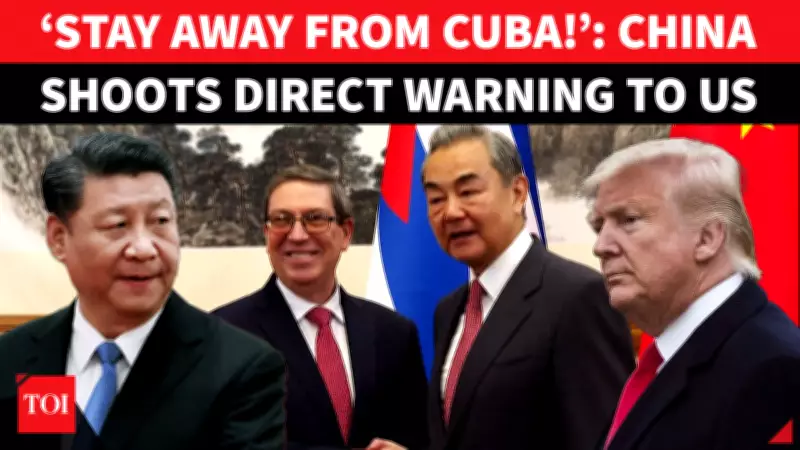
China Issues Stern Warning to US Over Cuba Policy
In a significant diplomatic development, China has delivered a forceful rebuke to the United States regarding its approach toward Cuba, with Chinese officials explicitly warning against actions that could "strangle Cuba's right to survival." This strong language comes amid escalating tensions between Washington and Havana, with Beijing positioning itself as a key supporter of the Caribbean nation.
Diplomatic Backing for Havana
Chinese Foreign Minister Wang Yi held discussions with his Cuban counterpart, Bruno Rodriguez Parilla, where he unequivocally expressed Beijing's support for Havana's efforts to safeguard national sovereignty and security. The diplomatic exchange represents a clear signal of China's growing involvement in Western Hemisphere affairs and its willingness to challenge US policies in the region.
"China stands firmly with Cuba in protecting its legitimate rights and interests," Wang Yi emphasized during the conversation, highlighting the deepening partnership between Beijing and Havana that has developed over recent years.

Venezuela Oil Disruption Impacts Cuba
The timing of China's intervention is particularly significant given recent developments affecting Cuba's energy security. The island nation had been heavily dependent on oil shipments from Venezuela, its long-time ally and primary energy supplier. However, this crucial supply chain was severely disrupted following US military action against Venezuela on January 3, which resulted in the capture of President Nicolas Maduro.
This disruption has created substantial challenges for Cuba's economy and energy infrastructure, exacerbating existing difficulties and creating what Chinese officials characterize as a humanitarian concern.
Trump's Hardline Stance on Cuba
The Chinese criticism comes as former President Donald Trump has intensified his rhetoric against the Cuban government, recently describing the country as a "falling nation" during public remarks. Trump's administration had previously rolled back Obama-era policies that had begun normalizing US-Cuba relations, reinstating tighter restrictions and sanctions.
Chinese officials have interpreted Trump's renewed criticism and the broader US approach as part of a pattern of increasing pressure on nations that maintain independent foreign policies from Washington's preferences.
Broader Geopolitical Implications
This diplomatic confrontation occurs against a backdrop of:
- Ongoing tensions between China and the United States across multiple fronts
- China's expanding influence in Latin America and the Caribbean
- Strategic competition between major powers in the Western Hemisphere
- Debates about sovereignty and non-interference in internal affairs
The Chinese statement represents more than just bilateral support for Cuba—it reflects Beijing's broader foreign policy approach that emphasizes:
- Respect for national sovereignty and territorial integrity
- Opposition to what it views as unilateral coercive measures
- Support for multilateral approaches to international disputes
- Development of alternative partnerships outside traditional Western alliances
As the situation continues to develop, observers are watching closely to see how this diplomatic exchange might influence:
- Future US policy toward Cuba and Venezuela
- China's growing role in Latin American affairs
- Regional dynamics in the Caribbean basin
- Broader great power competition between Washington and Beijing
The strong language from Chinese officials suggests that Beijing is prepared to take a more assertive stance in defending its partners and challenging US policies it views as detrimental to regional stability and development.






