

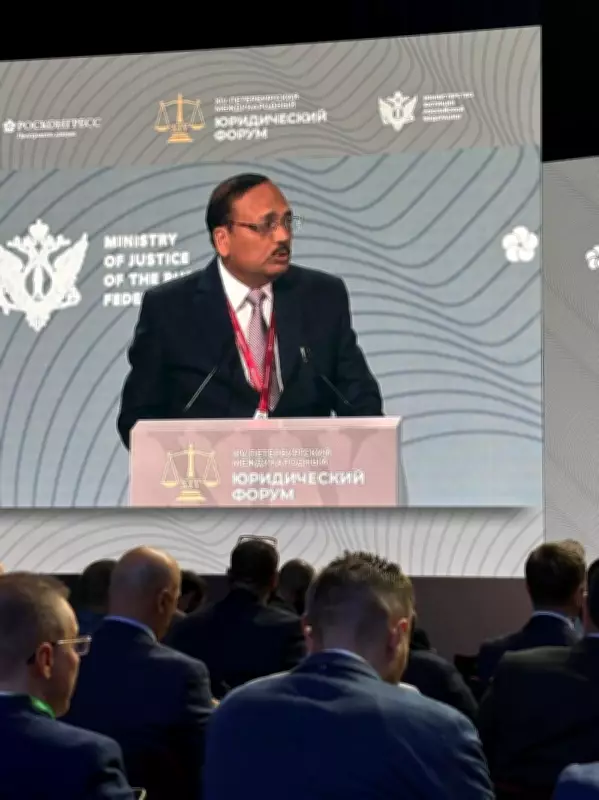
Chief Justice of India Surya Kant has asserted that international declarations and institutions cannot sustain the international legal order unless they are grounded in equal justice and equal law. Speaking at the 14th St Petersburg International Legal Forum in Russia on Wednesday, he addressed the theme "Equal Justice, Equal Law: Access as the Measure of International Law's Humanity."
Equal Justice and Equal Law as Foundations
"Equal justice and equal law are not ceremonial phrases. They are the conditions under which a legal order may credibly call itself law at all," CJI Kant said. He traced the concept of equality to Kautilya's 'Arthashastra,' which stated that a king who does not hold himself subject to dharma ceases to be a king, whether morally or actually. He noted that the principle of equality found its most ambitious modern expression in the Charter of the United Nations, which proclaimed in its very first Article the "Sovereign Equality of Nations Large and Small."
The CJI described fundamental principles of international law—such as jus cogens norms, obligations erga omnes, good faith, non-intervention, and pacta sunt servanda—as pivotal guardrails against international discretion. "To my mind, the above-cited principles are too fundamental to be traded away, and if vitiated, would injure and impair the legal conscience of humanity as a whole," he said.

Critique of Disparities in International Law
Justice Kant pointed out that developing nations in the Global East and South often face disproportionate international scrutiny and pressure, while wealthier nations are not always held to the same standards. "Numerous nations within the Global East and South are still in the process of constructing their institutions, addressing the repercussions of colonialism, and tackling poverty on a scale that the original drafters of international covenants could not have envisioned. These countries frequently endure scrutiny and pressure that are not proportionally applied to wealthier and more influential States, whose own compliance records are not necessarily irreproachable," he said.
He remarked that the fact that the question of whether international law is a privilege of the few or a law among equals must still be posed is "an indictment in itself."
Access to Justice as First Step
Describing equal access to law as the first step towards achieving equality, Justice Kant said access to law cannot remain a procedural formality and must result in the conferment of actual rights. "My answer, which I draw from my experience presiding over the world's largest and most complex judicial systems, is that the first step to equality is providing equal access to the law," he said.
Indian courts have progressively expanded access to justice by relaxing rules of legal standing, strengthening free legal aid, entertaining letters as public interest petitions, and treating procedure as a servant of justice, not its master. "We have learned that the most significant obstacle to equality is not the lack of legal or statutory support, but rather it is manifested on account of geographical, social, and economic disparities. Consequently, the Indian Constitutional Courts have interpreted and provided a broad and expansive interpretation of constitutional guarantees in order to eliminate all such barriers," he stated.
India-Russia Supreme Courts Sign MoU
Earlier, the Supreme Courts of India and Russia signed a Memorandum of Understanding on best practices in technology and justice administration in Moscow on Tuesday. A Joint Working Group will be established to develop strategies and mechanisms for sustained technological collaboration and deeper institutional engagement between the two judiciaries.






