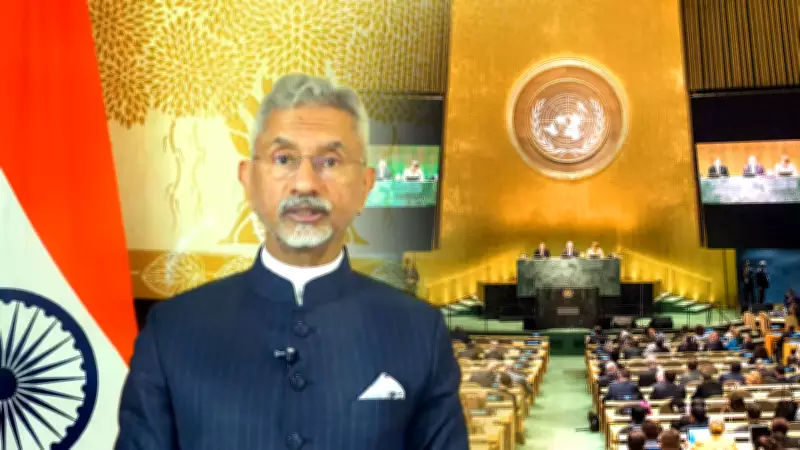
Jaishankar Delivers Strong Message Against Terrorism at UN Human Rights Council Session
External Affairs Minister Dr. S. Jaishankar delivered a powerful virtual address to the 61st session of the United Nations Human Rights Council (UNHRC), firmly reiterating India's unwavering dedication to the protection and promotion of human rights for all individuals globally. The minister's speech underscored a foundational principle that human rights are deeply embedded within India's ancient civilizational ethos and modern democratic framework.
India's Civilizational Commitment to Human Rights
In his comprehensive remarks, Jaishankar outlined the core tenets of India's approach to global human rights discourse. He championed a philosophy built on:
- Dialogue over confrontation as the primary means to resolve differences.
- Consensus over division to foster unity and collaborative progress.
- Human-centric development that prioritizes people's welfare above narrow or partisan interests.
This stance, he asserted, is not merely a policy position but a reflection of the country's long-standing values that view the well-being of every human as inseparable from the collective good of humanity.

Terrorism Condemned as a Grave Human Rights Violation
The minister took a unequivocal and hardline stance against terrorism, identifying it as one of the most severe violations of fundamental human rights. Jaishankar explicitly called for "zero tolerance" towards terrorist acts worldwide, urging the international community to adopt a unified and uncompromising position.
He elaborated that terrorism creates an environment of fear, insecurity, and violence that directly undermines the right to life, liberty, and security of person—cornerstones of the human rights framework. His message was clear: combating terrorism is intrinsically linked to upholding human rights.
A Call for Collective Global Action
Jaishankar emphasized the interconnected nature of global security and human dignity. He warned that insecurity or marginalization in any part of the world poses a direct threat to the well-being and stability of all nations. This perspective frames human rights not as a domestic issue but as a universal imperative requiring cooperative stewardship.
In this context, he made a direct appeal to the international community and the United Nations system to work collectively and with renewed vigor. The minister advocated for a coordinated effort to address the root causes of conflict and terrorism, thereby creating a more secure and rights-respecting global order.
India's Principled Stance on Peace and Security
The address positioned India's foreign policy as one guided by principle and consistency. Jaishankar articulated that India's stance at forums like the UNHRC reflects a principled approach to peace, security, and universal human rights. This approach seeks to balance national interests with global responsibilities, advocating for a world order where dialogue and development pave the way for lasting peace.
By linking the fight against terrorism to the broader human rights agenda, and by grounding its arguments in civilizational values and collective action, India's message at the UNHRC presented a comprehensive vision for international cooperation in the 21st century.